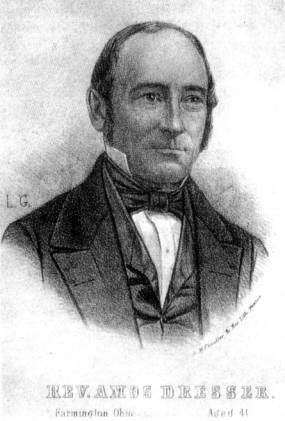
Entered according to Act of Congress in the year 1849,
THE BIBLE AGAINST WAR
BY
REV. AMOS DRESSER[1]
══════
�Blessed are the peacemakers.� � Matthew 5:3.
�There never has been, nor ever will be any such thing
as a good war or a bad peace.� � Benjamin Franklin.
══════
OBERLIN,
PRINTED FOR THE AUTHOR
MDCCCXLIX
TRANSCRIBED AND EDITED BY
WWW.nonresistance.info
2006
Entered according to Act of Congress in the year 1849,
BY AMOS DRESSER,
In the Clerk�s Office of the District Court of Ohio.
══════
JAMES M. FITCH, PRINTER,
OBERLIN, OHIO
CONTENTS
The definition of war
Much depends on the right state of heart
Careful investigation is required
English translation
The gospel is to interpret the law
The types of the Old Testament prefigure peace
Names applied to the Messiah
The prophets foretold a reign of peace
The reign of Christ is a reign of peace
The apostles were commissioned to preach peace
War is contrasted with the gospel
War has always been regarded as a curse
Peace is regarded as a blessing
No distinction between offensive and defensive war
The Canaanites were destroyed as sinners against God
The Jews were to share the same fate for the same sins
The destruction of Jericho
The destruction of Ai
God promised to fight the battles if they held their peace
God was true to his promise
The case of Hezekiah
The case of Jehoshaphat
Want of faith was the cause of their wars
They refused to follow the pillars of fire and cloud
Their constant murmurings provoked war
God has promised to avenge and protect his people
They who take the sword shall perish by the sword
They chose to defend themselves
They demanded a king to fight their battles
Various provocations
Reasons for their prosperity in war
The case of Elisha
The cases of Abijah and Asa, his son
The case of Gideon
The true believer and his echo
Romans 13 gives full authority for the use of the sword
Was the Roman government appointed of God?
The Revolutionary War is an illustration in point
Gibbon�s testimony of the early Christians
Christ�s instructions as to the defense of �sacred rights�
Peter�s rebuke for using the sword
The true meaning of Romans 13
Christ�s example on paying tribute
Other objections
Normally, I prefer to bring archaic language up to date, but I have elected to leave this volume almost as it was published, only correcting inconsistent punctuation, tense, language, and number, and removing some of the italics.
You may want to refer to the other Oberlin historical documents on the nonresistance.info website, particularly the Constitution of the Oberlin Nonresistance Society.� I wonder if Dresser took part in drafting it, considering that this book includes specific rebuttals to Professor Finney, President Mahan, and the ideals of the Oberlin Peace Society.
This transcription is under no copyright protection.� It is my gift to you.� You may freely copy, print, and transmit it, but please do not change or sell it.� Also, please point out any errors I have made so that I can fix them.�
Tom Lock
────
In my labors in the cause of peace for the few past years, I have found all, without exception, opposed to war.� All are ready to denounce it as a great evil and curse to mankind.� Many, very many, fully adopt the language of Professor Finney[2], and say, �War is one of the most heinous and horrible forms of sin unless it be evidently demanded by and prosecuted in obedience to the moral law.� Observe, war to be in any case a virtue, or to be less than a crime of infinite magnitude, must not only be honestly believed by those who engage in it to be demanded by the law of benevolence, but it must also be engaged in by them with an eye single to the glory of God and the highest good of being.� That war has been in some instances demanded by the spirit of the moral law there can be no reasonable doubt since God has sometimes commanded them.�
Surely no one acquainted with war could suppose that it could be carried on benevolently unless there was proof positive that God had commanded it.� This led me to carefully examine the Bible to see if indeed God did approve of what universal conscience condemns, if indeed God required man to do that which he instinctively shrinks from with abhorrence.� The result of my investigations I now present to the public, and they must judge of their worth.
The Bible is quoted to justify defensive war.� But if it justifies war at all, it justifies offensive and aggressive war, such as none in our day approve.� Yet most feel that self-defense is a privilege and duty; that great as is the evil of war, it is nevertheless right to fight sometimes.� But, �if it can be proved that defensive wars are allowable, it would be altogether useless to pursue the inquiry any further, because, under the name and pretext of defensive war, national contests of every description would be carried on.� Every belligerent nation, with scarcely a single exception, scornfully rejects the imputation of being the original aggressor, and professes to prosecute its warlike measures for purposes of self-protection.� And so long as we admit that defensive wars are allowable on Christian principles, we grant, for all practical purposes, everything that the advocates of war wish.� The true doctrine is that human life, both in its individual and corporate state, as one and as many, IS INVIOLABLE; that it cannot be taken away for any purpose whatever, except by explicit divine permission; and that war, in every shape, and for every purpose, is wrong, absolutely wrong, wholly wrong.� Any doctrine short of this will fall altogether powerless and useless upon the broad surface of the world�s crimes and miseries; it will dim the light of no sword; it will wipe the tear of no widow or orphan.� � Professor Upham.[3]
�Even the revelations of commerce prohibit war; and shall the religion of the Ledger outweigh the religion of Jesus Christ?� If that religion will admit any defensive war, our hopes are extinguished forever; for the last words of the author of it were, �it is finished.�� Nothing can be added, and nothing taken away.� Let the human race come to this sacred volume for their guidance, and read its prohibitions against all war.� It may be imputed to fanaticism and ultra-ism, but it has come to this: that if the gospel forbids all war, then there never was, and there never will be, a period when its demands were more imperative than now.� The greatest prerogative conferred upon us this side of heaven is to dwell together in love, and have God dwelling with us.� In view of this, the apostle exclaimed, �That neither principalities nor powers, nor things present nor things to come, could separate us from the love of God which is in Christ Jesus or Lord.�
�The highest demonstration of Christianity which a man can give is to forgive his enemies.� Thus war makes it a capital crime to exercise the capital virtue of Christianity!
�The whole world is looking to Christianity for the blessings of peace.� The down-trodden millions who have been crushed under the burdens of the grim Moloch of war, and are lifting up their lean, shriveled hands, and crying for bread, are looking to us Christians, imploringly, to stay the awful devastations of war; that they may have opportunity to rise again to the dignity of manhood.� And it is for us to remember, that if we perforate the great law of love, which is to cement and bind together in harmony all races of men, even with so much as a bodkin, we make a hole large enough to admit all the fiends of the pit and deluge with blood the whole face of this beautiful green earth.� � Elihu Burritt.[4]
�But can it be that those who justify war understand what war is?� Give a glance at its awful havoc of human life.� It has destroyed at Durham, 15,000; at Agincourt, 20,000; at Bautzen and Lepanto, 25,000; at Austerlitz, Jena, and Lutzen, 30,000 each; At Eylau 60,000; at Waterloo and Quatre Bras, in one engagement, in fact, 70,000; at Borodino, 80,000; at Fontenoy, 100,000; at Yarmouth, 150,000; at Chalons, 300,000 of Attila�s army alone.� Julius Caesar, in one engagement, slew 363,000; in another, 400,000; in a third, 430,000.� Genghis Khan, in one district, butchered 1,600,000, and, in his long reign of more than forty years, sacrificed some 32,000,000 lives!� Grecian wars are supposed to have destroyed 15,000,000; Jewish wars, 25,000,000; the wars of the twelve Caesars, 30,000,000 in all; the wars of the Roman Empire, of the Saracens and the Turks, 60,000,000 each; the wars of the Tartars, 80,000,000; those of Africa, 100,000,000; during the whole history of war, no less according to Dr. Dick, than 14,000,000,000, or, according to Burke, 35,000,000,000!!� � Peace Manual, p. 33.[5]
Thus at the lowest estimate war has devoured more than fourteen times as many as all the inhabitants on the globe!� Shall the enemy devour forever?� And then what havoc of virtue and all that makes life dear!� Take a single paragraph in the description of the sacking of Magdeburg:[6] �Neither the innocence of childhood, nor the helplessness of old age � neither youth, sex, rank, nor beauty � could disarm the fury of the conquerors.� Wives were dishonored in the arms of their husbands, daughters at the feet of their parents; and the defenseless sex exposed to the double sacrifice of virtue and life.� No condition, however obscure, or however sacred, could afford protection from the rapacity of the enemy.� Fifty-three women were found beheaded in a single church.� The Croats amused themselves by throwing children into the flames, Pappenheim�s Walloons with stabbing infants at their mothers� breasts.� Some officers of the League, horror-struck at this dreadful scene, ventured to remind Tilly that he had it in his power to stop the carnage.� �Return in an hour,� was his answer, �and I shall see what is to be done; the soldier must have some recompense for his danger and toils.� � Peace Manual, pp. 29,30.
�Stabbing infants, and throwing children into the flames� is the soldier�s amusement!� �The soldier must have some recompense for his danger and toils!�
Or come nearer home and take a mere glimpse of some of the refinements of our late war with Mexico.� Says a spectator, �As at Matemoras, MURDER, ROBBERY, and RAPE were committed in the broad light of day.
�On arriving at Mier, we learned from indisputable authority that outrages of the most disgraceful character had been committed against the citizens: stealing, or rather robbing, insulting the women, breaking into houses, and other feats of a similar character!� We have heard of them at almost every rancho up to this place.
�The women have been repeatedly violated (almost an every-day affair), houses are broken open, and insults of every kind have been offered to those whom we are bound by honor to protect.� � Facts for the people, pp. 109-111.[7]
These are but a part of the usual and necessary concomitants of war.� Are they what God approves?
Yet no doubt many will be slow to believe that the wars of Joshua, David, & Co. were not carried on with the perfect approbation of heaven.� I can heartily sympathize with such, for the idea that they were thus carried on has been instilled into my own mind from my youth, and there are many passages that seem to favor that idea; but careful, faithful research has fully convinced me that the Bible does not teach that doctrine.� I know not that what I have written will produce the same convictions in the minds of others.� All I wish is to have each for himself diligently �search the scriptures,� and if I can even awaken new zeal in the performance of this too much neglected duty and privilege, I shall feel myself amply rewarded for my labor.� I have tried to arrange various passages so as to assist in this delightful work, and my prayer is that the Holy Spirit may accompany their perusal, and give the same satisfaction to the soul of the reader that it has to the compiler.� I am conscious of the many imperfections of the work, still I can but hope it may help to hasten the day when �Righteousness and Peace shall kiss each other,� and nations shall learn war no more.� That that day is approaching none can doubt who has carefully observed the signs of the times.� All who have studied the wonderful events of the past year, in the light of God�s precious promises, can heartily say,
�There�s a good time coming,
A good time coming:
War in all men�s eyes shall be
A monster of iniquity
In the good time coming.
Nations shall not quarrel then
To prove which is the stronger;
Nor slaughter men for glory�s sake �
Wait a little longer.
The reformation has begun �
Wait a little longer.�[8]
────
�To the law and to the testimony: if they speak not according to this word, it is because there is no light in them.� � Isaiah 8:20.
�Search the scriptures.� � John 5:39.
�Search the scriptures.�� A blessed requirement.� How seldom obeyed.� Many occasionally read the scriptures; how few who search them.� Hence, so little is known of their precious treasures.� They contain choice gems not found on the surface, and the deeper the mine the more valuable the gold.� Time is not lost in searching the scriptures.
In commenting on these passages, it will be my object, by example, to give what I consider the best method of obeying the text.� That is to take a given subject and, carefully comparing passage with passage, find the teachings of the whole Bible on that point.� Let us then search the scriptures and learn God�s will on the subject of WAR and PEACE.� There are may who think God once sanctioned war, and urge that �whatever may be the teachings of the gospel, it cannot be denied that the Old Testament justifies war, and as the Bible never sanctions what is wrong, it follows that war cannot be a malum in se.�� Hence, on the part of some, the peace injunctions of the gospel are so explained as to make them null and void, while others reject the Old Testament, because, as they say, it does not harmonize with the New.� It is therefore meet we should search the scriptures, Old and New, and the soul that searches them panting for the knowledge of God will be fed.� They testify of the Faithful and True Witness, and He testifies of war.� Hear ye Him.
By war I do not mean simply the taking of human life, for though it is true that the annihilation of capital punishment annihilates war, yet it is not true that to authorize capital punishment authorizes war.� We find the punishment of death inflicted on the blasphemer, the murderer, the slaveholder, the incorrigibly disobedient child, the parent who gave his children to Moloch (the god of war), on the adulterer, the incestuous, the sodomite, the bestial, the wizard, the witch, the enticer to idolatry, the idolater, etc.� See Leviticus 20, 24:11-17; Exodus 21:16; Deuteronomy 21:18-21, 13:6, 13:10, 17:2-5; Numbers 15:32-36; etc.� But it would be altogether a misnomer to apply the term war to the execution of this sentence.� More will be said of this as we proceed.
Nor do I mean by war simple self-defense, for whatever may be the teachings of Christ relative to nonresistance, impulsive self-defense differs widely from war.� �Self-defense is independent of law.� It knows no law.� It springs from the tempestuous urgency of the moment, which brooks neither circumspection nor delay.� Define it, give it law, circumscribe it by a code, invest it with form, refine it by punctilio, and it becomes the duel.� And modern war, with its innumerable rules and regulations, its limitations and refinements, is the duel of nations�� War is a public armed contest between nations in order to establish justice between them.� � Sumner.[9]
�A contest between nations or states carried on by force.� � Webster.[10]
Carried on according to military tactics, maxims, and customs, under military discipline � this is the technical and legitimate sense of the term war.� As thus defined �
Does the Bible Sanction War?
In attempting to answer this question, I would by way of introduction premise that the Bible is a faithful record of facts.� It often records as a matter of history what it by no means sanctions.� For example, the evangelist gives a correct account of the crucifixion of Christ, saying nothing at the time condemning it.� Are we therefore to conclude that heaven approves of this deed of infamy?� By wicked hands He was crucified and slain.�
Much depends on the state
of heart for the right
interpretation of the bible.
The Bible is often quoted to sustain slavery, intemperance, licentiousness, and nearly every sin committed in Christendom; and certain states of mind might possibly see a justification of these crimes in the passages quoted.� But Christ spoke to the Jews �in parables because they seeing, saw not, � their heart was waxed gross, their ears were dull of hearing, their eyes they had closed,� etc.� They had no love for the truth, and the Savior spoke in a manner designed and calculated to develop the true state of their hearts.� The lover of truth, by searching, is made to know the mysteries of the kingdom of heaven.� The lover of sin, by his caviling, is left to bring to light that love of sin.� Hence the tippler quotes, �Drink no longer water, but a little wine for thy stomach�s sake, and for thine often infirmities.�� The slaveholder or his apologist with an air of triumph, repeats, �Of them shall ye buy bondmen and bondmaids, and they shall be your possession forever!�� The lover of war brandishes his sword as he gives you his authority for its use, by quoting, �Thou shalt smite them, and utterly destroy them.�� So Saul �verily thought he ought to do many things contrary to the name of Jesus of Nazareth.�� But the difficulty was in his persecuting heart.� The scales fell from his eyes the moment love entered his heart.� When converted, he opened and alleged from scripture that Jesus was the Christ.� The same book that before declared the �Nazarene� to be an imposter was now full of the proof of his Messiahship.� Was the blame in the book, or in the heart that interpreted it?� �As a man thinketh in his heart, so is he.�� At the same time it is cheerfully admitted that there are �
Passages not easily
understood without
careful examination.
For example, Deuteronomy 7:2 reads, �Thou shalt smite them and utterly destroy them, thou shalt make no covenant with them, nor show mercy unto them,� which appears to be directly at variance with Luke 6:27‑36: �Love your enemies, do good to them which hate you, bless them which curse you, and pray for them which despitefully use you and persecute you.� �� Be ye therefore merciful, as your Father also is merciful.�
So in Deuteronomy 17:14-15 the Lord directs, �When thou art come into the land which the Lord thy God giveth thee, and shalt possess it, and shalt dwell therein, and shalt say, �I will set a king over me like as all the nations that are about me,� thou shalt in any wise set him king over thee whom the Lord thy God shall choose,� etc.� And when the time comes, and a king is demanded, Jehovah selects the man, and directs the prophet to anoint him (see 1 Samuel 8 and 9), yet in Hosea 13:11, He says, �I gave thee a king in mine anger, and took him away in my wrath.�� Again in Deuteronomy 24:1-4, instructions are given for �putting away� wives, yet in Malachi 2:16 God says, �He hateth putting away,� and in Matthew 5:32, Christ forbids it �saving for the cause of fornication.�� In Mark 10:2-12, a full explanation is given.� These cases will serve to show the importance of careful investigation.
Especially is this true of our English translation.� Far be it from me to do anything to prejudice the mind against our valuable translation.� Yet the translators were uninspired men, liable to err.� They had not the light upon many moral subjects by which to interpret various passages, nor had they the advantages for ascertaining the true meaning, which now, in the progress of literature and science, everywhere abound.� It is therefore by no means arrogant to suppose that improvements may be made.� For illustration, I will cite only one case out of the many that might be mentioned.� �To sit on my right hand and on my left is not mine to give, but it shall be given to them for whom it is prepared of my Father.� � Matthew 20:23.� (See context.)� Upon which Dr. Barnes,[11] in his valuable notes, makes the following criticism.� �The translation of this place evidently does not express the sense of the original.� The translation expresses the idea that Jesus has nothing to do in bestowing rewards on his followers.� This is at variance with the uniform testimony of the scriptures.� (See Matthew 25:31-40 and John 5:22.)� The correct translation of the passage would be, �To sit on my right hand and on my left is not mine to give, except to those for whom it is prepared of my father,� etc.�
Hence I have given what is supposed to be a correct translation of various passages where the original is more expressive than our present version, which, it is to be remembered, was made at a time when war, slavery, and many other gross immoralities were thought by the mass of the church to be consistent with Christianity.� But it is not the peace man alone who meets with difficult passages.� Nay, verily, it is much more difficult to explain away the passages which teach peace than those which are thought to teach war.
Again I premise that if in any respect the Old Testament apparently clashes with the New, in that case the gospel is to be our guide, as we are Christians and not Jews.� But I say apparently, for as God is the author of each there can be no real clashing.� Prof. Finney is explicit on this point.� �There cannot be a difference between the spirit of the Old and New Testaments, or between the spirit of the law and the gospel, unless God has changed and unless Christ has undertaken to make void the law through faith, which cannot be.� � Skel. Lect. On Theol. p. 242.[12]
But the gospel is denominated �the gospel of peace.� � Ephesians 6:15.� In the New Testament, God is everywhere spoken of as a �God of Peace.� � Romans 15:33, 16:20; 2 Corinthians 13:11; 1 Thessalonians 5:23; Hebrews 13:20; etc.
The types and shadows of the
old testament all prefigure
a dispensation of peace.
For example, a palace is to be built for the King of kings and Lord of lords.� It is to be hallowed by the presence of Jehovah, and his name is to be called upon in it, �that all the people of the earth may know that Jehovah is God.� None else � that his name may be magnified forever, saying, �The Lord of hosts is the God of Israel � a God to Israel.��� It is to shadow forth his true character, and in many particulars to foreshadow the dispensation of the Spirit.� Its builder, in many respects is to be a type of the great Architect of the gospel temple.� In speaking of this, God says to David, �Thou hast shed blood abundantly, and made great wars; thou shalt not build a house unto my name, because thou hast shed much blood upon the earth in my sight.� Behold, a son shall be born to you who shall be a man of rest; and I will give him rest from all his enemies round about, for his name shall be Solomon, and I will give peace and quietness unto Israel in his days.� He shall build a house for my name, and he shall be my son, and I will be his father.� � 1 Chronicles 22:8-10.� The meaning of the name Solomon is peace.� His name shall be Peace!� An appropriate name, truly, for the Son of the God of peace � who was especially �raised up� to erect this wonderful edifice so quietly made �that there was neither hammer, axe, nor any tool of iron heard in the house while it was in building.�� Is all this without a meaning?
The names by which the
messiah is designated in
the Old Testament show
that the gospel was to be
a dispensation of peace.
Names in the Bible are significant.� That is, men and things are known by their names.� Hence Prince of Peace is the name given by the prophets to the foretold Messiah. � Isaiah 9:6.� So in Genesis 49:10, Jacob, in prophetic blessing of his sons, says, �The scepter shall not depart from Judah nor a law-giver from between his feet, until Shiloh come.�� The meaning of Shiloh is �Peace Maker.�� Hence, says Scott,[13] �All allow that the Messiah was intended, who was sent into the world as the promised seed to be the �Prince of Peace.��� Henry[14] translates it, �That Peaceable and Prosperous One, or the Savior.�� Though in the primary sense the term may apply to his making peace between God and man, yet it is equally true that He makes peace between man and man.� This is further evident from the fact that �
the prophets everywhere
characterize the reign of
Christ as a reign of peace
among men.
For example, �He shall judge among the nations, and shall rebuke many people, and they shall beat their swords into plow-shares and their spears into pruning hooks.� Nation shall not lift up sword against nation; neither shall they learn war any more.� � Isaiah 2:4.� �Rejoice greatly, O daughter of Zion; shout, O daughter of Jerusalem.� Behold thy King cometh unto thee.� He is just, and having salvation; lowly, and riding upon an ass, and upon a colt the foal of an ass.� And I will cut off the chariot from Ephraim, and the horse from Jerusalem, and the battle-bow shall be cut off.� And he shall speak peace unto the heathen, and his dominion shall be from sea to sea and from the rivers to the ends of the earth.� � Zechariah 9:9.� �But I will have mercy upon the house of Judah, and will save them by the Lord their God, and will not save them by bow, nor by sword, nor by battle, by horses, nor by horsemen.� � Hosea 1:7.� �And in that day will I make a covenant for them with the beasts of the field, and with the fowls of heaven, and with the creeping things of the ground; and I will break the bow and the sword and the battle out of the earth, and will make them to lie down safely.� � Hosea 2:18.� Implying that there is no safety in implements of war, and to this the bloody history of the world says, �Amen.�
�Save them by the Lord � and not by the sword.�� Mark the antithesis.� Those saved by the Lord are not saved by the sword.� The Lord never appointed the sword for protection or safety.
This is no ephemeral affair, for �of the increase of his government and peace there shall be no end.� The zeal of the Lord of hosts will perform this.� � Isaiah 9:6-7.� And yet there is neither anarchy nor confusion, for �With righteousness shall he judge the poor, and reprove with equity for the meek of the earth.� He shall smite the earth with the rod of his mouth, and with the breath of his lips shall he slay the wicked.� And righteousness shall be the girdle of his loins, and faithfulness the girdle of his reins.� The wolf also shall dwell with the lamb, the leopard shall lie down with the kid, and the calf and the young lion and the fatling together, and a little child shall lead them.� The cow and the bear shall feed, their young ones shall lie down together, and the lion shall eat straw like the ox.� And the sucking child shall play on the hole of the asp, and the weaned child shall put his hand upon the cockatrice�s den.� They shall not hurt or destroy in my entire holy mountain, for the earth shall be full of the knowledge of the Lord as the waters cover the sea.� � Isaiah 11:4-9.
Here is no �rapine, murder, and death.�� They shall lie down safely.� None shall hurt nor destroy.� For God shall be their refuge and strength.� ►► We are not to wait for these things till there are no wolves, leopards, and lions.� The power of the gospel is to be felt in subduing the wild and ravening nature of these ferocious animals.� That this can be done is now being fully illustrated by the happy labors of that angel of mercy, Miss Dix[15], in our prisons and insane hospitals.� It was illustrated in the case of William Penn,[16] by the Moravians, and by the early Christians.� It has been illustrated whenever and wherever Christianity has been exhibited in its purity and power.
� and the nations who hear his rebuke �Learn war no more.�� Hence the messengers of heaven sent to announce his birth shouted, �Glory to God in the highest, and on earth Peace.� Among men, benevolence!�� The huge gates of Janus that for seven hundred years had been open to the chariot of war, now creaked upon their rusty hinges, for all was peace.� O, what an hour was that!� The reign of grace had commenced, and good will among men was inscribed on the banner of the throng, as they shouted, �Behold thy King cometh unto thee, meek, sitting upon an ass and a colt, the foal of an ass.� Blessed is He that cometh in the name of the Lord!� Hosanna in the highest!�� Then the inaugural, how sublime!� �Blessed are the poor in spirit, for theirs is the kingdom of heaven.� Blessed are they that mourn, for they shall be comforted.� Blessed are the meek, for they shall inherit the earth.� Blessed are they which do hunger and thirst after righteousness, for they shall be filled.� Blessed are the merciful, for they shall obtain mercy.� Blessed are the pure in heart, for they shall see God.� Blessed are the peacemakers, for they shall be called the children of God.� Blessed are they which are persecuted for righteousness� sake, for theirs is the kingdom of heaven.� Blessed are ye when men shall revile you, and persecute you, and shall say all manner of evil against you falsely for my sake�� Think not that I am come to destroy the law or the prophets.� I am not come to destroy, but to fulfill.� The law says, �Thou shalt not murder.�� I say, thou shalt indulge in no passion that leads to murder.� The law says, �An eye for an eye, and a tooth for a tooth.�� I say, resist not evil, but howsoever shall smite thee on thy right cheek, turn to him the other also.� Ye have heard that it hath been said, �Thou shalt love thy neighbor and hate thine enemy.�� But I say unto you, love your enemies.� Bless them who curse you.� Do good to them that hate you, and pray for them who despitefully use you and persecute you, that ye may be the sons of your Father in Heaven.� For if ye love them that love you, what grace have ye, for sinners do even the same.� Be ye therefore merciful, as your Father also is merciful.� Forgive, and ye shall be forgiven.� � Matthew 5 and Luke 6, Greek.
Enemies were conquered
by the gospel.
Such are the teachings of the Lawgiver in the dispensation of peace.� He found extreme cases, and his principles were severely tested.� Did his practice correspond with his teachings, and did He succeed in subduing enmity?� Yes, and enemies were made friends.� �While we were yet sinners, Christ died for us.� When we were enemies we were reconciled to God by the death of his son.� � Romans 5:8-10.� He died for us, and in the agonies of death, cried, �Father, forgive them.�� �And you that were sometime alienated, and enemies in your mind by wicked works, yet now hath he reconciled.� � Colossians 1:21.
Glory to God!� The plan is not a failure!� By example Christ has shown us how to convert enemies into friends, and has left this as our peculiar work.� �For this is grace, if a man, for conscience toward God, endures grief, suffering wrongfully.� For what is the honor if having sinned, ye suffer for it, and take it patiently?� But if ye suffer for doing good, and take it patiently, this is grace from God.� ►► For to this were ye called, because Christ also suffered for you, leaving you an example that ye shall follow his steps.� (A glorious example!� A blessed calling!� O, that it was better understood, and more generally followed!)� Who did no sin, neither was guile found in his mouth; who when He was reviled, reviled not again.� When He suffered, He threatened not, but committed Himself to Him who judgeth righteously, who his ownself bore our sins in his own body to the tree, that we being dead to sin should live unto righteousness, by whose stripes ye were healed.� For ye were as sheep going astray, but are now returned unto the Shepherd and Keeper of your souls.� � 1 Peter 2:19-25, Greek.
Hence says Jesus, �Behold I send you forth as sheep in the midst of wolves.� Be ye therefore wise as serpents, and harmless as doves.� But beware of men, for they will deliver you up to the councils, and in their synagogues, they will scourge you, and ye shall be brought before Rulers and Kings on my account for a testimony to them, and the gentiles.� � Matthew 10:16-18.� �And it shall turn to you for a testimony.� � Luke 21:13.� �Be not at all terrified, by your adversaries, for unto you it is graciously given in the behalf of Christ not only to believe on him, but also to suffer for his sake.� � Philippians 1:28-29, and thereby have a blessed opportunity to bear testimony as to the peculiar power of the gospel and show that returning good for evil is as �the fragrance the bruised flower yields to him who tramples on it.�� In these trying circumstances �let your light so shine before men, that they may see your good works, and glorify your Father in heaven.�� � Ye shall be betrayed both by parents and brethren, and relatives and friends, and they shall put some of you to death, and ye shall be hated by all men for my name�s sake, but there shall not a hair of your head perish.� By patient enduring preserve your souls.� � Luke 21:14-19.� �These things I command you, that ye love one another.� If the world hates you, ye know that it hated me before it hated you.� If ye were of the world, the world would love its own but because ye are not of the world, but I have chosen you out of the world, therefore the world hateth you.� Remember the word that I said unto you, the servant is not greater than his Lord.� If they have persecuted me, they will also persecute you�� But when the Comforter is come, whom I will send to you from the Father, the Spirit of truth who proceedeth from the Father, He shall testify of me.� Ye also are to bear witness, because from the beginning ye are with me.� � John 15:17-27.� ��Peace go with you.� As the Father hath sent me, even so I send you.�� And having said this, He inspired them, and said, �Receive ye the Holy Ghost.�� � John 20:21-22.
The apostles were set apart to
this work by solemn prayer.
O how responsible our calling, and in view of such responsibility, how impressive the ordaining prayer!� �Holy Father, keep, through thine own name, those whom thou hast given me, that they may be one as we are�� I have given them thy word, and the world has hated them, because they are not of the world, even as I am not of the world.� I pray not that thou shouldst take them out of the world, but that thou shouldst keep them from the evil.� They are not of the world, even as I am not of the world.� Consecrate them to thy truth.� Thy word is truth.� As thou hast sent me into the world, so have I sent them into the world.� I consecrate myself for them, that they also may be consecrated to the truth.� I pray not for these alone, but for them also who shall believe on me through their word; that they all may be one, as thou, Father, in me, and I in thee, that they all may be one in us; that the world may believe that thou hast sent me.� And I have given to them the glory which thou hast given to me, that they may be one as we are one; I in them and thou in me, that they may be made perfect in one, and that the world may know that thou hast sent me, and hast loved them as thou hast loved me.� � John 17:11-23.�
Then, with such a trust and such promises, how appropriate are the instructions of the apostle.� �Beloved, think it not strange concerning the fiery trials which are to try you, as though some strange thing happened to you, but rejoice in proportion as ye are partakers in Christ�s sufferings, that when his glory shall be revealed, ye may be glad also with exceeding joy.� If ye are reproached for the name of Christ, happy are ye because the Spirit of glory and of God resteth upon you.� By them He is blasphemed, by you He is glorified.� � 1 Peter 4:12 etc.�
The mission was fulfilled
and the commission was
renewed by the apostles.
Such was the light by which Jesus Christ illumined this dark world, and such the work entrusted to us.� The apostles, true to their calling, reflected the same light and signed over the same commission to their successors.� �The servant of the Lord must not fight, but be gentle towards all, patiently enduring evil, skillful in teaching, by meekness instructing the opposers, peradventure God may give them repentance unto the exact knowledge of the truth, and so they shall recover[17] from the snare of the devil, having been led captive by him into his will.� � 2 Timothy 2:24-26, Greek.
�Recompense to no man evil for evil.� Take special pains to do things which commend themselves to the consciences of all.� If it be possible, so much as lieth in you, live peaceably with all men.� Dearly beloved, avenge not yourselves but rather give place unto wrath, for it is written, �Avenging is mine, I will repay,� saith the Lord.� Therefore, if thine enemy hunger, feed him, and if he thirst, give him drink, for in so doing, thou shalt heap coals of fire on his head.� Be not overcome of evil, but overcome evil with good.� � Romans 12:17-21.� �Why do ye not rather take wrong?� Why do ye not suffer yourselves to be defrauded?� � 1 Corinthians 6:7.� �I will very gladly spend and be spent for you, though the more abundantly I love you the less I be loved.� � 2 Corinthians 12:15.� �Even unto this present hour we both hunger and thirst and are naked, and are buffeted, and have no certain dwelling place, and labor, working with our own hands.� Being reviled, we bless; being persecuted, we suffer it; being defamed, we entreat; we have become as the filth of the world � the offscouring of all things unto this day.� � 1 Corinthians 4:11-13.� �Of the Jews, five times received I forty stripes save one, thrice was I beaten with rods, once was I stoned,� � 2 Corinthians 11:24-25, says Paul, yet when at Caesar�s judgment seat, instead of suing for redress, his forgiving plea is, �Not that I had aught to accuse my nation of.�� �So also they stoned Stephen, while he, calling upon God, said, �Lord Jesus receive my spirit,� and he kneeled down and with a loud voice cried, �Lord, lay not this sin to their charge,� and when he had said this he fell asleep.� � Acts 7:59-60.� Amid a shower of stones, �he fell asleep.�� Ah, this is grace!� Do we see anything like it in war?
Let us compare our commission
and the spirit of the gospel
with the soldier�s commission
and the spirit of war.
Lord Nelson,[18] the military lawgiver of England�s Midshipmen says, �There are three things which you are constantly to bear in mind.� 1st. You must always implicitly obey orders without attempting to form any opinion of your own respecting their propriety.� 2nd. You must consider every man your enemy who speaks ill of your king.� 3rd. You must hate a Frenchman as you hate the devil.� � Peace Manual, p. 116.
Says Napoleon, �The worse the man, the better the soldier,� and Lieutenant Page,[19] in the agonies of death � his bloody tongue no longer able to blaspheme � in fiendish exultation writes, �We gave the Mexicans HELL.�� This is war.� And surely Lord Wellington[20] was right in saying, �Men who have nice notions about religion have no business to be soldiers.�� The early Christians were right in saying, �I am a Christian, and therefore I cannot fight.�
�Let us now put war and Christianity side by side, and see how far they agree.� Christianity saves men; war destroys them.� Christianity elevates men; war debases and degrades them.� Christianity purifies men; war corrupts and defiles them.� Christianity blesses men; war curses them.� The gospel says, thou shalt not kill; war says, thou shalt kill.� The gospel says, blessed are the peace-makers; war says, blessed are the war-makers.� The gospel says, love your enemies; war says, hate them.� The gospel says, forgive men their trespasses; war says, forgive them not.� The gospel enjoins forgiveness and forbids revenge; war scorns the former, and commands the latter.� The gospel says, resist not evil; war says, you may and must resist evil.� The gospel says, if any man smite thee on one cheek, turn to him the other also; war says, turn not the other cheek, but knock the smiter down.� The gospel says, bless those who curse you; bless, and curse not; war says, curse those who curse you; curse, and bless not.� The gospel says, pray for those who despitefully use you and persecute you; war says, pray against them, and seek their destruction.� The gospel says, see that none shall render evil for evil unto any man; war says, be sure to render evil for evil unto all that injure you.� The gospel says, overcome evil with good; war says, overcome evil with evil.� The gospel says, if thine enemy hunger, feed him; if he thirst, give him drink; war says, if you supply your enemies with food and drink you will be shot as a traitor.� The gospel says, do good unto all men; war says, do as much evil as you can to your enemies.� The gospel says to all men, love one another; war says, hate and kill one another.� The gospel says, they that take the sword, shall perish by the sword; war says, they that take the sword, shall be saved by the sword.� The gospel says, blessed is he that trusteth in the Lord; war says, cursed is such a man, and blessed is he that trusteth in swords and guns.� God says, beat your swords into ploughshares, your spears into pruning hooks, and learn war no more; war says, make swords and spears still, and continue to learn war.
�War in its spirit, its principles, its legitimate results, is antagonistic to Christianity.� Peace was the song chanted over her cradle by angels fresh from the God of love.� Her Founder was the Prince of Peace; her gospel is the statute book of peace; the principles of peace are scattered throughout the New Testament, and most fully were they enforced by the example of Christ, his apostles, and all his early disciples.
�Glance at the general contrariety of war to the gospel.� Says Dr. Malcom,[21] �War contradicts the very genius and intention of Christianity.� Christianity, if it prevailed, would make the earth a paradise; war, wherever it prevails, makes it a slaughterhouse, a den of thieves, a brothel, a hell.� Christianity is the remedy for all human woes; war produces every woe known to man.� All the features, all the concomitants, all the results of war, are the opposite of the features, the concomitants, the results of Christianity.� The two systems conflict in every part, irreconcilably and eternally.�
��The whole structure of any army is in violation of New Testament precepts.� What absolute despotism!
��Condescending to men of low estate,� would spoil discipline.� �Esteeming others better than ourselves� would degrade the officers.� Instead of humility, there must be gay trappings.� Instead of Christ�s law of love, there must be man�s rule of honor.� Instead of examining all things, the soldier must be like a trained bloodhound, ready to be let loose against any foe.� Instead of returning good for evil, the army is organized expressly to return injuries with interest.� The qualities required in the Christian spoil a soldier for the field.� He must then cast away meekness, and fight.� He must cast away honesty, and forage.� He must cast away forgiveness, and revenge his country.� He must return blow for blow, wound for wound.� Thus, when we take the common soldier individually, we find him compelled to violate every precept of his religion.
�Let us state a few points that will be conceded by all.�
�1. The deeds of war, in themselves considered, are confessedly forbidden in the New Testament, and can be justified only on the supposition that government has a right, in war, to reverse or suspend the enactments of Heaven.
�2. The spirit of war is acknowledged by all to be contrary to that of the gospel.� But can we have war without its spirit?� What is the spirit of any custom or act but the moral character of that custom or act?� Blasphemy without the spirit of blasphemy!� Perpetrate the deeds of war without the spirit of war, and destroy property, life, and happiness by wholesale, from motives of pure benevolence!� Kill men just for their own benefit!� Send them to perdition for their own good!!� Tremendous logic; yet the only sort of logic that ever attempts to reconcile war with the gospel; a logic that would require us to suppose that thousands of cut-throats by profession, generally unprincipled and reckless, fierce, irascible and vindictive, the tigers of society, will shoot, and stab, and trample one another down in the full exercise of Christian patience, forgiveness, and love!!
�3. The qualities required of warriors, are the reverse of those which characterize the Christian.� Even Paley,[22] the ablest champion of war, avers that �no two things can be more different than the Heroic and the Christian characters,� and then proceeds to exhibit the two in striking contrast as utterly irreconcilable.� Must not war itself be equally incompatible with Christianity?
�4. The gospel enjoins no virtue which the soldier may not discard without losing his military rank or reputation; nor does it forbid a solitary vice which he may not practice without violating the principles of war.
�5. While the gospel prescribes rules for every lawful relation and employment in life, it lays down not a single principle applicable to the soldier�s peculiar business, and evidently designed for his use.� If war is right, why this studious avoidance, this utter neglect of its agents?
�6. The Old Testament predicts that the gospel will one day banish war from the earth forever.� But if consistent with Christianity, how will the gospel ever abolish it?� The gospel destroy what it sanctions and supports!
�7. Christians, in the warmest glow of their love to God and man, shrink with instinctive horror from the deeds of cruelty and blood essential to war; nor can they, in such a state of mind, perpetrate them, without doing violence to their best feelings.
�8. Converts from paganism, in the simplicity of their first faith, have uniformly understood the gospel as forbidding this custom.� Such was remarkably the case in the South Sea Islands; and the fact goes far to prove that no mind, not under the hereditary delusions of war, would ever find in the gospel any license for its manifold abominations.
�But let the New Testament speak for itself.� It may forbid war either by a direct condemnation of it, or by the prohibition of its moral elements, the things which go to constitute war; and we contend that the gospel does forbid it in both these ways.
�1. Note first its express condemnation of war.� �From whence come wars and fightings among you?� Come they not hence, even of your lusts?� � James 4:1.� We cannot well conceive a denunciation more direct or more decisive.� Our Savior before Pilate declared, �If my kingdom were of this world, then would my servants fight; but now is my kingdom not from hence.� � John 18:36.� A most unequivocal condemnation of war as inconsistent with Christianity.� �Follow peace with all men.� � Hebrews 12:14.� Or, as it is in the original, �Seek earnestly, with all your might, after peace, not only with your own countrymen, but with foreigners; not with your friends alone, but with your enemies; with the whole human race.�� What language could, if these passages do not, condemn war as utterly un-Christian?
�2. But look at the still more decisive mode of forbidding war by the condemnation of its moral elements.� The gospel puts them all under ban.� War contravenes the fundamental principle of Christianity.� This principle is, enmity subdued by love, evil overcome with good, injury requited by kindness.� It pervades the whole New Testament; it is the soul of the Christian system.� The peculiar precepts of the gospel all rest on this principle; nor can we take it away without subverting the entire fabric of Christianity.� But this principle is incompatible with war, because war always aims to overcome evil with evil, to return injury for injury, to subdue our enemies by making them wretched, to inflict on our assailants the very evils they meditate against us, to save our own life, property, and happiness by sacrificing theirs.� Such is war in its best form; but, if this be not a contradiction of the gospel, we know not what is, and challenge you to conceive a principle more directly opposed to that which lies at the foundation of Christianity.
�But the gospel condemns in detail the moral elements of war.� �Lay aside all malice; and let all bitterness, and wrath, and anger be put away.�� �Avenge not yourselves.�� �Recompense to no man evil for evil.�� �See that none render evil for evil to any man.�� �Whereas there is among you envying, and strife, and division, are ye not carnal?�� �Now, the works of the flesh are these: hatred, variance, emulation, wrath, strife, sedition, envyings, murders, revilings, and such like.�� Need any one be told that the things here denounced are inseparable from war, and constitute its very essence?� What!� War without bitterness, wrath, or anger, without variance, emulation, or murder!� Nations go to war without avenging themselves, and rendering evil for evil!
�The gospel, however, still more fully condemns war by enjoining what is inconsistent with it.� �Thou shalt love thy neighbor as thyself;� and the parable of the Good Samaritan makes every human being our neighbor.� �Love worketh no ill to his neighbor; therefore, love is the fulfilling of the law.�� �Charity (love) suffereth long and is kind; seeketh not her own; is not easily provoked; thinketh no evil; beareth all things, believeth all things, hopeth all things, endureth all things.�� �Do good unto all men.�� �Whatsoever ye would that men should do unto you, do ye even so to them.�� �By this shall all men know that ye are my disciples, if ye have love one to another.�� �Have peace one with another.�� �The fruit of the Spirit is love, joy, peace, long-suffering, and forbearing one another.�� �Forgive one another, even as Christ forgave you.�� �The wisdom which is from above, is first pure, then peaceable, gentle, and easy to be entreated.�� �Blessed are the poor in spirit, the meek, the merciful, the peacemakers.�� �Resist not evil, but whosoever shall smite thee on thy right cheek, turn to him the other also.�� �Overcome evil with good.�� �Love your enemies, bless them that curse you, do good to them that hate you.�� � Peace Manual, pp. 139,147-153.
Surely the Spirit of the New Testament is wholly opposed to war.� Therefore the spirit of the Old Testament must be opposed to war, as they each have the same Author, unchanged and unchangeable.
Christ was the angel
of the old covenant.
We see then that if Christ is our teacher, we �learn war no more.�� But Christ was the �Angel� of the old covenant also, whose �voice� they were to �obey.�� Jesus Christ was �that Prophet� to whom they were to �hearken.� �(See Deuteronomy 18:15 and Acts 3:22-23.)� And the promises relating to the �land� were all connected with promises relating to Christ.� (See Genesis 12:1-4, 28:13-14, and Galatians 3:14-16.)� And it was evidently God�s design that the Jews should, on entering Palestine, �enter into rest.�� (See Hebrews 3 and 4.)� �A rest� from all war � from the lusts of the flesh � a rest such as is found in Christ Jesus � such as results from obeying the gospel, so that if the Jews were men of war it was because they would not hearken to the �Prince of Peace.�� And the Jewish wars were no more in accordance with the will of God than are the wars of our day.� In each case they result from a love of war rather than peace.� I do not however mean that war was ever approved by the reason[23] or conscience of man.� Quite the contrary �
War is now and always has
been regarded as a curse.
Even General Taylor says, �I sincerely rejoice at the prospect of peace.� My life has been devoted to arms, yet I look upon war, at all times and under all circumstance, as a NATIONAL CALAMITY, to be avoided if compatible with national honor.� � Allison Letter.[24]
Hence, the Bible classes war with the �famine,� the �pestilence,� and other judgments of sin.� �I will send the sword, the pestilence, and the famine among them until they be consumed from off the land.� � Jeremiah 24:10.� So Gad came to David and said to him, �Thus saith the Lord, choose thee either three years� famine, or three years to be destroyed before thy foes, while that the sword of thine enemies overtaketh thee, or else three days the sword of the Lord, even the pestilence in the land and the angel of the Lord destroying throughout all the coasts of Israel.�[25]� - 1 Chronicles 21:11-12.
I repeat then, in the language of Cruden,[26] �War is threatened of God in scripture as one of the greatest judgments, and may justly be reckoned among the many miseries which sin has entailed on mankind.�� ►► War is a curse not simply to the aggressor, but to each party � to all engaged in it.
The bible speaks of peace
as a blessing � the result
of obedience and faith.
For example, �The Lord will bless his people with peace.� � Psalm 29:11.� �The work of righteousness shall be peace, and the effect of righteousness, quietness and assurance forever; and my people shall dwell in a peaceable habitation and in sure dwellings and in quiet resting places.� � Isaiah 32:17-18.� �Because we have sought the Lord our God � we have sought and He has given us rest on every side.� � 2 Chronicles 14:7.� �I will hear what God the Lord will speak: for He will speak peace unto his people and his saints; but let them not turn again to folly.� Surely his salvation is nigh them that fear Him, that glory may dwell in our land.� Mercy and truth are met together.� Righteousness and peace have kissed each other.� � Psalm 85:8-10.� �The wisdom that is from above, is first pure, then peaceable, gentle, easy to be entreated, full of good fruits, without partiality and without hypocrisy, and the fruit of righteousness is sown in peace by those who practice peace.� � James 3:17-18.� �But there is no peace saith my God to the wicked.� � Isaiah 48:22.�
The bible makes no distinction
between offensive and
defensive war.[27]
Yes, and what is more, the wars which the Bible is said to sustain were aggressive, such as no one now thinks of justifying.� President Polk and General Taylor did not fulfill to the letter the injunction, �Thou shalt save alive nothing that breathes,� � Deuteronomy 20:16, and yet I have heard no one complain of their mercy.[28]
The Canaanites were doomed
to destruction because of
their sin.
That God had a sacred right to destroy the inhabitants of the old world by a flood, and Sodom by fire and brimstone, all admit who regard Him as man�s righteous Sovereign and Creator.� Jehovah alone can give life, and it is his prerogative to take life.� If he has a right to do it in person, he has a right to select his own means and commission whom he will as executioners.� As to the antediluvian world, �God saw that the wickedness of man was great in the earth, and that every imagination of the thoughts of his heart was only evil continually,� � Genesis 8:5, and benevolence demanded their destruction.� Of Sodom, the Lord said, �Because the cry of Sodom and Gomorrah is great, and because their sin is very grievous, I will go down now, and see whether they have done altogether according to the cry of it which has come unto me; and if not I will know.� � Genesis 18:20-21, and when he found them perfectly steeped in licentiousness, beyond all hope of recovery, He commissioned his destroying angels to go forth upon their work of death, who said, �We will destroy this place because the cry of them is waxen great before the Lord: and the Lord hath sent us to destroy it.� � Genesis 19:13.� It would be strange indeed to argue that because the angels had a commission to destroy Sodom, therefore, it was right to destroy mankind everywhere according to their discretion; and much more strange would be the logic that would urge that angels generally could destroy mankind anywhere and everywhere, because certain angels had been commissioned to a certain work of destruction for specific reasons.� But this would be no stranger than to urge that because the Jews had a divine commission to destroy the Canaanites, therefore, mankind in general can destroy one another at their discretion.
The very fact of a restrictive commission shows that the work was not lawful without a commission.
God saw the increasing iniquity of the Canaanites, and foreseeing that benevolence would eventually demand their extirpation, promised the land they then occupied to Abraham and his seed, interdicting his immediate possession because �the iniquity of the Amorites was not yet full.� � Genesis 15:16.� But when their cup became filled to the brim, so that their continued existence would but prove a curse to themselves and to all over whom they had influence, he gave the heirs to understand that they could take possession.
The work of destruction was entrusted to the Jews, not because there was any enmity between them, nor because their �national honor� was at stake.� It was because the Canaanites were the enemies of Jehovah, opposed to all good and given up to every abomination, that they were to be �consumed from off the land.�� This is evident from Deuteronomy 18:12.� �Because of these abominations, the Lord thy God doth drive them out from before thee.� (See the context.)� �And the land is defiled: therefore do I visit the iniquity thereof upon it, and the land itself vomiteth out her inhabitants.� � Leviticus 18:25.� See also Leviticus 20:22-23 and parallel passages.
Nor was it because the Jews were in a state of faith and acceptance with God, so that they were called to possess the land.� Jehovah again and again reiterated that it was not for the faith and righteousness of God�s people, but for the abominations of the Canaanites that He drove them out.� Hence He says, �Speak not thou in thy heart, after that the Lord thy God hath cast them out from before thee, saying, �For my righteousness the Lord hath brought me in to possess this land,� but for the wickedness of these nations the Lord doth drive them out from before thee.� Not for thy righteousness, or for the uprightness of thy heart dost thou go to possess their land, but for the wickedness of these nations, the Lord thy God doth drive them out from before thee, and that He may perform the word which the Lord sware unto thy fathers Abraham, Isaac, and Jacob.� Understand therefore, that the Lord thy God giveth thee not this good land to possess it for thy righteousness, for thou art a stiff-necked people.� Remember, and forget not, how thou provokedst the Lord thy God to wrath in the wilderness; from the day that thou didst depart out of the land of Egypt, until ye came unto this place, ye have been rebellious against the Lord� � Deuteronomy 9:4-7.� More will be said of this later.
The Jews were to Experience
the same judgments if guilty
of the same abominations.
The Jews themselves were to share the same fate, if guilty of the same crimes.� �And it shall be that if thou do at all forget the Lord thy God, and walk after other gods, and serve them, and worship them, I testify against you this day, that ye shall surely perish.� As the nation which the Lord destroyeth before your face, so too shall ye perish; because ye would not be obedient unto the voice of the Lord your God.� � Deuteronomy 8:19-20.� See also Deuteronomy 17:2-5, Leviticus 18:24-30, and 20:22-23.� Thus, when they had made and bowed down to the golden calf, Moses commanded the sons of Levi to �put every man his sword by his side, and go in and out from gate to gate throughout the camp, and slay every man his brother, and every man his companion, and every man his neighbor.� And the children of Levi did according to the word of Moses, and there fell of the people that day about three thousand men.� � Exodus 32:27-28.� Was this war?!
There was NEITHER WAR
NOR fighting when the
Jews exercised faith in God.
Whenever they had faith in God as a �grain of mustard seed� there was no fighting.� The enemies of Jehovah, terror-stricken at his presence, submitted themselves, as in the case of the guilty Israelites before the sons of Levi; as did the inhabitants of Jericho to Joshua and his host, as they went forth in the stillness of death, bearing the ark of Jehovah, with no battering rams, nor implements of any kind for demolishing the city save the �seven trumpets of the jubilee.�� Day after day, for six successive days they encompassed the city, exposing themselves to the jeers of the idolaters, as though by the blowing of rams� horns their strong walls were to crumble!� But their faith and patience did not fail.� They �waited upon God,� and seven times on the seventh day they went round about the city, still sounding their trumpets, till at the seventh time Joshua said to the people, �Shout, for the Lord hath given you the city.�� And it came to pass when the people heard the sound of the trumpet, and the people shouted with a great shout, that �the wall fell down flat; so that the people went up into the city, every man straight before him and took the city.� � Joshua 6.� Thus, �by faith,� not by force, the walls of Jericho fell.[29]� Here was no fighting � no �contest� � but the simple execution of divine law upon the wicked, as each man went in straight before him, and entered upon his mission of death.� It is altogether a misnomer to call this war.� Who ever heard of a war where the slain were all of one party, and the whole party slain?� Who ever heard of a war where the fighting (?) was all on one side?� ►► It takes two to fight.� Yet there is no evidence that a single Israelite was slain, nor that a single inhabitant of Jericho lifted his hand in resistance to the executioners.� Does this look like what we call war?!
The judgment of war was
inflicted on them for sin.
But, as at other times when God honored them, they were filled with pride and attempted the destruction of Ai in their own wisdom and strength.� And Joshua, contrary to the divine injunction (see Numbers 27:12), �asked not counsel at the mouth of the Lord,� but sent out spies, who, self-confident, returned saying, ��Let not all the people go up, but let about two or three thousand men go up and smite Ai; make not all the people to labor thither, for they are but few.�� So there went up of the people about three thousand men, and they fled before the men of Ai.� And the men of Ai smote of them about thirty-six men: wherefore the hearts of the people melted, and became as water.� And Joshua rent his clothes, and fell to the earth upon his face before the ark of the Lord until the even-tide, he and the elders of Israel, and put dust upon their heads.�� Even Joshua had lost his former faith and began to repent that they had passed over the Jordan.� He penitently poured forth his prayer to God, and was heard.� �The Lord said unto Joshua, �Get thee up; wherefore liest thou upon thy face?� Israel hath sinned, and they have also transgressed my covenant which I commanded�� Therefore the children of Israel could not stand before their enemies, but turned their backs before their enemies, because they were accursed; neither will I be with you any more, except ye destroy the accursed from among you.�� � Joshua 7.� The curse of war was upon them, because they had sinned, and remained upon them till the accursed were put away from among them, till thoroughly humbled they were again willing to look to God for instruction.
If war was what they expected, how can we account for their astonishment, that out of three thousand they �lost� thirty-six men?� ►► Those who obey and trust God are never obliged to fight.� Such are �saved by the Lord their God, and not by the sword.�
The constant liability of the
Jews to fall into idolatry
and sin was one reason why
God appointed them to the
work of destruction.
God evidently selected the Jews to fulfill his purposes of wrath upon the idolaters because of their constant tendency to fall into the same sin.� For the same reason all his judgments were performed �before their face.�� But for this, their actual transgressions, and their own choice, God would have been his own avenger of blood.� Their whole history is replete with evidence on this point.� Had it not been for the �hardness of their hearts,� had they not refused to �hearken to that prophet,� they would not have been called to act even as executioners.� He inflicted his judgments upon Egypt without their agency.� When hotly pursued by their oppressors, the mountains on either side and the Red sea before them, and thus apparently shut up to certain and utter destruction, they cried to Moses, �Because there were no graves in Egypt, hast thou taken us away to die in the wilderness?�� Moses said to the people, �Fear ye not: stand still and see the salvation of the Lord which he will show you this day�� The Lord shall fight for you, and you shall hold your peace�� And the Egyptians shall know that I am the Lord when I have gotten me honor upon Pharaoh.�
►► This is the mode of procedure he had designed.� All along He reminded them of what he did to Egypt � of the �wonders their eyes saw,� and promises to do to all the inhabitants of Canaan as He had done to Pharaoh and his host � if they would obey his voice.
The promise is, �The Lord your God which goeth before you, He shall fight for you according to all that He did for you in Egypt before your eyes.� � Deuteronomy 1:30.� �Ye shall not fear them, for the Lord your God, He shall fight for you.� � Deuteronomy 3:22.� �If thou shalt say in thine heart, �These nations are more than I,� how can I dispossess them?� Thou shalt not be afraid of them, but shalt well remember what the Lord thy God did unto Pharaoh and unto all Egypt, the great temptations which thine eyes saw, and the signs and the wonders and the mighty hand and the stretched out arm, whereby the Lord thy God brought thee out.� So shall the Lord thy God do unto all the people of whom thou art afraid.� � Deuteronomy 7:17-19.� �If ye shall diligently keep all these commandments which I command you, to do them � to love the Lord your God, to walk in all his ways, and to cleave unto him � then will the Lord drive out all these nations from before you�� Behold I set before you this day a blessing and a curse � a blessing if ye will obey the commandments of the Lord your God � and a curse if ye will not obey.� � Deuteronomy 11:22-28.� �Behold I send an angel before thee in the way and to bring thee into the place which I have prepared: beware of him and obey his voice; provoke him not, for he will not pardon your transgressions, for my name is in him.� But if thou shalt indeed obey his voice, and do all that I speak, then I will be an enemy unto thine enemies, and an adversary to thine adversaries.� For my angel shall go before thee and bring thee unto the Amorites, and the Hittites, and the Perizites, and the Canaanites, and the Hivites, and the Jebusites, and I will cut them off�� I will send my fear before thee, and will destroy all the people to whom thou shalt come, and I will make all thine enemies turn their backs unto thee, and I will send hornets before thee,� etc. � Exodus 23:20-30.� (See also Joshua 3:10 and Deuteronomy 31:6-8.)
He promised to do to Canaan as he had done to Egypt.� God was his own executioner in Egypt, and He would have been in Canaan if it were not for their own choice and lack of faith in God.
The Canaanites expected God
would fulfill His promises.
Such was God�s promise, and even the heathen expected this promise would be fulfilled.� �Rahab said unto the men, �I know that the Lord hath given you the land, and that your terror is fallen upon us, and that all the inhabitants of the land faint because of you.� For we have heard how the Lord dried up the water of the Red sea for you, when ye came out of Egypt; and what ye did unto the two kings of the Amorites that were on the other side of the Jordan, Sihon and Og, whom ye utterly destroyed.� And as soon as we had heard these things, our hearts did melt, neither did there remain any more courage in any man, because of you: for the Lord your God, he is God in heaven above, and in earth beneath.� � Joshua 2:9-11.� �And it came to pass when all the kings of the Amorites which were on the side of Jordan westward, and all the kings of the Canaanites which were by the sea, heard that the Lord had dried up the waters of Jordan from before the children of Israel, until we were passed over, that their hearts melted; neither was there spirit in them any more, because of the children of Israel.� � Joshua 5:1.� The heathen knew well enough of Jehovah to believe He would do as He had said.
God was true to his
promise whenever the
condition was fulfilled.
�God is not a man that He should lie; neither the son of man that He should repent.� Hath he said, and shall He not do it?� Or hath He spoken, and shall He not make it good?� � Numbers 23:19.� �It is better to trust in the Lord than to put confidence in man.� It is better to trust in the Lord than to put confidence in princes.� � Psalm 118:8-9.� �And they that believe on Him shall not be confounded.�
The history of Hezekiah furnishes an illustration in point.� When �Sennacherib king of Assyria came and entered into Judah and encamped against the fenced cities, and thought to break them up � Hezekiah the king, and the prophet Isaiah the son of Amoz, prayed and cried to heaven.� And the Lord sent an angel which cut off all the mighty men of valor and the leader, and captains in the camp of the king of Assyria.� So he returned with shame of face to his own land.� And when he was come to the house of his god, they that came forth of his own bowels slew him there with the sword.� Thus THE LORD saved Hezekiah and the inhabitants of Jerusalem from the hand of Sennacherib the king of Assyria.� � 2 Chronicles 32:1,20-22.
� furnishes another striking example of the power of faith, and the safety of trusting God.� �The children of Moab, and the children of Ammon, and with them other besides the Ammonites, came against Jehoshaphat to battle.� Then there came some that told Jehoshaphat, saying, �There cometh a great multitude against thee from beyond the sea, on this side Syria; and behold they be Hazazon-tamar, which is En-gedi.�� And Jehoshaphat feared, and set himself to seek the Lord, and proclaimed a fast throughout all Judah.� And Judah gathered themselves together, to ask help of the Lord; even out of all the cities of Judah they came to seek the Lord.� And Jehoshaphat stood in the congregation of Judah and Jerusalem, in the house of the Lord, before the new court, and said, �O Lord God of our fathers, art not thou God in heaven?� And rulest not thou over all the kingdoms of the heathen?� And in thine hand is there not power and might, so that none is able to withstand thee?� Art not thou our God, who didst drive out the inhabitants of this land before thy people Israel, and gavest it to the seed of Abraham thy friend forever?� And they dwelt therein, and have built thee a sanctuary therein for thy name, saying, if, when evil cometh upon us, as the sword, judgment, pestilence, or famine, we stand before this house and in thy presence (for thy name is in this house), and cry unto thee in our affliction, then thou wilt hear and help.� And now behold, the children of Ammon and Moab and Mount Seir, whom thou wouldest not let Israel invade when they came out of the land of Egypt, but they turned from them and destroyed them not; behold, they reward us, to come to cast us out of thy possession, which thou hast given us to inherit.� O, our God, wilt thou not judge them?� For we have no might against this great company that cometh against us; neither know we what to do; but our eyes are upon thee.�� And all Judah stood before the Lord with their little ones, their wives, and their children.� Then upon Jahaziel, the son of Zechariah, the son of Bennaiah, the son of Jeiel, the son of Mattaniah, a Levite of the sons of Asaph, came the Spirit of the Lord in the midst of the congregation; and he said, �Hearken ye, all Judah, and ye inhabitants of Jerusalem, and thou king Jehoshaphat.� Thus saith the Lord unto you, be not afraid nor dismayed by reason of this great multitude, for the battle is not yours but God�s.� Tomorrow go ye down against them.� Behold, they come up by the cliff of Ziz; and ye shall find them at the end of the brook, before the wilderness of Jeruel.� ►► Ye shall not need to fight in this battle; set yourselves, stand ye still, and see the salvation of the Lord with you.� O Judah and Jerusalem, fear not nor be dismayed; tomorrow go out against them, for the Lord will be with you.�� And Jehoshaphat bowed his head, with his face to the ground, and all Judah and the inhabitants of Jerusalem fell before the Lord, worshiping the Lord.� And the Levites of the children of Hohathites, and of the children of the Korbites, stood up to praise the Lord God of Israel with a loud voice on high.� And they rose early in the morning, and went forth into the wilderness of Tekoa.� And as they went forth, Jehoshaphat stood and said, �Hear me, O Judah, and ye inhabitants of Jerusalem.� Believe in the Lord your God; so shall ye be established.� Believe his prophets; so shall ye prosper.�� And when he had consulted with the people, he appointed singers unto the Lord, and that should praise the beauty of holiness as they went out before the army, and to say, �Praise the Lord, for his mercy endureth forever.�� And when they began to sing and to praise, the Lord set ambushments against the children of Ammon, Moab, and Mount Seir, which were come against Judah; and they were smitten.� For the children of Ammon and Moab stood up against the inhabitants of Mount Seir, utterly to slay and destroy them: and when they had made an end of the inhabitants of Seir, every one helped to destroy another.� And when Judah came toward the watch-tower in the wilderness, they looked unto the multitude, and behold they were dead bodies fallen to the earth, and none escaped.� And when Jehoshaphat and his people came to take away the spoil of them, they found among them in abundance both riches with the dead bodies, and precious jewels (which they stripped off for themselves), more than they could carry away; and they were three days in gathering of the spoil, it was so much.� And on the fourth day they assembled themselves in the valley of Berachah; for there they blessed the lord; therefore the name of the same place was called the valley of Berachah, unto this day.� Then they returned every man of Judah and Jerusalem, and Jehoshaphat in the forefront of them, to go again to Jerusalem with joy, for the Lord had made them to rejoice over their enemies.� And they came to Jerusalem with psalteries and harps and trumpets, unto the house of the Lord.� And the fear of God was on all the kingdoms of those countries when they had heard that the Lord fought against the enemies of Israel.� So the realm of Jehoshaphat was quiet: for his God gave him rest round about.� � 2 Chronicles 20:1-30.
He is now at no loss for an answer to the question, �What would you do in extreme cases?�� �God is our refuge and strength, a very present help in time of trouble.� Therefore will not we fear, though the earth be removed, and though the mountains be carried into the midst of the sea.� Though the waters thereof roar and be troubled, though the mountains shake with the swelling thereof.� Selah.� There is a river, the streams whereof shall make glad the city of God, the holy place of the tabernacles of the Most High.� God is in the midst of her; he shall not be moved; God shall help her, and that right early.� The heathen raged, the kingdoms were moved; he uttered his voice, the earth melted.� The Lord of hosts is with us; the God of Jacob is our refuge.� Selah.� Come; behold the works of the Lord, what desolations he hath made in the earth.� He maketh wars to cease unto the end of the earth; he breaketh the bow, and cutteth the spear in sunder; he burneth the chariot in the fire.� Be still and know that I am God; I will be exalted among the heathen; I will be exalted in the earth.� The Lord of hosts is with us; the God of Jacob is our refuge.� Selah.� � Psalm 46.[30]
This was the result of Jehoshaphat�s faith (I say �Jehoshaphat�s faith,� �for as yet the people had not prepared their hearts unto the God of their fathers.� � 2 Chronicles 20:33), as he did �that which was right in the sight of the Lord.�
The want of this faith was
the cause of their war
and bloodshed.
At the commencement of their journeyings, it was promised, �The Lord shall fight for you, and you shall hold your peace.�� God�s reason for leading them through the wilderness was to keep them out of the sight of war.� �God led them not through the way of the land of the Philistines, although that was near, for God said, lest peradventure the people repent when they see war, and they return to Egypt.� � Exodus 13:17.� And even after their repeated transgressions in the wilderness (by which they had once again provoked war), as they are about to pass over Jordan, God said, �Know this day that Jehovah is thy God.� He going before thee is a consuming fire.� He shall destroy them, or He shall humble them before thy face, and thou shalt dispossess them, and cause them to wander, hastening.� � Deuteronomy 9:3, Hebrew, and again, �The Lord your God, He shall expel them from before you, and drive them from out of your sight, and ye shall possess their land as the Lord your God hath promised you.� Be ye therefore very courageous to keep and do all that is written in the book of the law of Moses, that ye turn not aside therefrom to the right hand or to the left.� � Joshua 23:2,6.� ►► It needs more courage to obey God than it does to fight.� �The Lord your God which goeth before you, He shall fight for you according to all that He did for you in Egypt, before your eyes�� Yet in this thing ye did not believe in the Lord your God, who went in the way before you to search you out a place to pitch your tents; in fire by night to show you by what way ye should go, and in a cloud by day.� � Deuteronomy 1:30,32.
Again and again the complaint was made against them that �they would not confide in God�s going before them to guide and direct as he had planned.�� (See Exodus 13:21-22; Numbers 9:15-23, 10:34; Nehemiah 9:12-19.)� But, distrustful of God, they sent spies to see whether it would be safe or expedient to obey Him.� �We will send MEN before us, and they shall search us out the land, and bring us word again by what way we must go up and into what cities we must come � and the Lord heard the voice of your words and was wroth, and sware, saying, �There shall not one of these men of this evil generation see that good land,�� etc.� � Deuteronomy 1:22-36.� �But Jeshurun waxed fat and kicked � he forsook God which made him, and lightly esteemed the rock of his salvation.� They provoked Him to jealousy with strange gods and with abominations, provoked they Him to anger.� They sacrificed unto devils, not to God�� And when the Lord saw it, He abhorred them because of the provoking of his sons and daughters.� And He said, �I will hide my face from them; I will see what their end shall be; for they are a very froward generation � children in whom is no faith�� The sword without and the terror within shall destroy both the young man and the virgin; the suckling with the man of gray hairs�� O, that they were wise, that they understood this, that they would consider their latter end.� How shall one chase a thousand, and two put ten thousand to flight, except their Rock had sold them, and the Lord had shut them up.� For their rock is not as our Rock, even our enemies themselves being judges.�� � Deuteronomy 32:15-31.� �O, that thou hadst hearkened to my commandments!� Then had thy peace been as a river, and thy righteousness as the waves of the sea.� � Isaiah 48:18.
�But my people would not hearken to my voice, and Israel would none of me, so I gave them up unto their own heart�s lusts, they walked in their own counsels.[31]� O that my people had hearkened unto Me, and Israel had walked in My way, I should soon have subdued their enemies and turned my hand against their adversaries.� The haters of the Lord should have submitted themselves unto him.� But their time should have endured forever.� � Psalm 81:11-15.
Their murmuring commenced immediately upon their leaving Egypt, and continued almost unceasingly till they were finally destroyed.� Again and again had they rebelled against Jehovah and provoked him to anger by distrust, saying, �Is the Lord among us or not?� before they were made to taste the bitter dregs of war (and then their success was made to depend on Moses� intercessions).
From Genesis to Revelation God proffers himself as the �REFUGE,� the �DEFENSE,� the �HIDING PLACE,� the �HIGH TOWER,� the �SALVATION� of his people; and never are thy obliged to fight in self-defense when willing to trust Him.� �Avenging is mine, I will repay, saith the Lord; therefore if thine enemy hunger feed him.� � Romans 12:19-20, etc.� �He shall judge the poor of the people, He shall save the children of the needy, and shall break in pieces the oppressor.� � Psalm 72:4.� �For he shall deliver the needy when he crieth; the poor also, and him that hath no helper.� He shall spare the poor and needy, and shall save the souls of the needy.� He shall redeem their soul from deceit and violence, and precious shall their blood be in his sight.� � Psalm 72:12-14.� �Hearken unto me, ye that know righteousness, the people in whose heart is my law; fear ye not the reproach of men, neither be ye afraid of their revilings.� For the moth shall eat them up like a garment, and the worm shall eat them like wool; but my righteousness shall be forever, and my salvation from generation to generation.� Awake, awake, put on strength, O arm of the Lord.� Awake, as in the ancient days, in the generations of old.� Art thou not it that hath cut Rahab, and wounded the dragon?� Art thou not it which hath dried the sea, the waters of the great deep; that hath made the depths of the sea a way for the ransomed to pass over?� Therefore the redeemed of the Lord shall return, and come with singing unto Zion; and everlasting joy shall be upon their head.� They shall obtain gladness and joy, and sorrow and mourning shall flee away.� I, even I, am He that avengeth you.� Who art thou that thou shouldest be afraid of a man that shall die, and of the son of man which shall be made as grass?� And (who art thou that) forgettest the Lord thy maker, that hath stretched forth the heavens, and laid the foundations of the earth; and hast feared continually every day, because of the fury of the oppressor, as if he were ready to destroy?� And where is the fury of the oppressor?� � Isaiah 51:7-13, etc.� See also Deuteronomy 32:35-43, Hebrews 10:30, etc.
It is God�s arrangement that
they who take the sword
shall perish by the sword.
�Surely your blood of your lives will I require.� (Not, shall ye require.)� Whoso sheddeth man�s blood by man shall his blood be shed.� � Genesis 9:5,9,6.� �He that leadeth into captivity shall go into captivity.� He that killeth with the sword must be killed with the sword.� Here is the patience and faith of the saints.�� - Revelation 13:10.
Proof from history of the
providential fulfillment
of these promises
Universal history testifies that this prediction has been verified to the letter.� Hence, says President Mahan[32] in the Oberlin Evangelist of March 15, 1848, under the caption, �He that taketh the sword shall perish with the sword:�
�How strikingly verified that maxim is in the recent revolution in France.� No monarch in Europe, probably, had taken the pains to throw around his throne, for self-protection, such a forest of glittering bayonets, as had Louis Philippe.� Yet, by the very means by which he purposed to hold the populace in subjection was his own throne overturned.� When will oppressors, civil and ecclesiastical, learn wisdom from the providence of God?�
Safety is found in the exercise
of patience and faith.
And I would add, when will the people of God learn that they do not need the sword for protection?� When will they realize that their safety is in their patience and their faith?� Their strength is to sit still.� �For thus saith the Lord God, the Holy One of Israel, in returning (that is, repenting) and rest shall ye be saved, in quietness and confidence shall be your strength � and ye would not.�
Here was the difficulty with the Jews.� They �would not� trust God.
They chose to defend
themselves, and God, in
anticipation of their
rebellion, gave them
laws in view of it.
�The Lord said unto Moses, Behold thou shalt sleep with thy fathers, and this people will rise up and go a whoring after the gods of the strangers of the land whither they go to be among them, and will forsake me, and break my covenant, which I have made with them.� Then my anger shall be kindled against them in that day, and I will forsake them, and I will hide my face from them, and they shall be devoured.� � Deuteronomy 31:16-18.� And so it was.� �Thus saith the Lord God.� In the day when I chose Israel, and lifted up my hand unto the seed of the house of Jacob, and made myself known unto them in the land of Egypt, when I lifted up my hand unto them, saying, I am the Lord your God, in the day I lifted up my hand unto them to bring them forth of the land of Egypt, into a land that I had espied for them, flowing with milk and hone, which is the glory of all lands, then said I unto them, �Cast ye away every man the abominations of his eyes, and defile not yourselves with the idols of Egypt.� I am the Lord your God.�� But they rebelled against me, and would not hearken unto me.� I gave them my statutes and showed them my judgments, which if a man do he shall even live in them�� But the house of Israel rebelled against me in the wilderness.� They walked not in my statutes, and they despised my judgments, which if a man do he shall live in them� �Wherefore I gave them also statutes that were not good, and judgments whereby they should not live.�� - Ezekiel 20:1-25.
Thus we can account for the commands to go and fight � for his command to appoint a king, etc. �All the elders of Israel gathered themselves and came unto Samuel unto Ramah, and said unto him, �Behold thou art old, and thy sons walk not in thy ways.� Now make us a king to judge us like all the nations.�� But the thing displeased Samuel, when they said �give us a king to judge us.�� And Samuel prayed unto the Lord, and the Lord said unto Samuel, �Hearken unto the voice of the people in all that they say unto thee, for they have not rejected thee, but they have rejected me, that I should not reign over them.� According to all the works which they have done since the day I brought them up out of Egypt, even unto this day, wherewith they have forsaken me, and served other gods, so do they also unto thee.� Now therefore hearken unto their voice.� Howbeit yet protest solemnly unto them, and show them the manner of the king that shall reign over them.�� Nevertheless the people refused to obey the voice of Samuel, and they said, �Nay, but we will have a king over us, that we also may be like the nations, and that our king may judge us, and go out before us, and fight our battles.��
Here is the secret: �That he may fight our battles.�� They wished to defend their �national honor,� and �stand up for their rights.�
�Hence, they despised the God of peace, and �their heart went after their idols� of war.� They took up the tabernacle of Moloch,[33] and the star of their god Remphan.[34] � Acts 7:43, Amos 5:26.� �They served their idols, which were a snare unto them.� Yea, they sacrificed their sons and daughters unto devils.� � Psalm 106:36-37.� �How oft did they provoke Him in the wilderness, and grieve Him in the desert!� Yea, they turned back and tempted God, and limited the Holy One of Israel.� They remembered not his hand, nor the day when He delivered them from the enemy.� � Psalm 78:40-42.� �They provoked Him to anger with their high places, and moved Him to jealousy with their graven images.� When God heard this, He was wroth, and greatly abhorred Israel.� So that He forsook the tabernacle of Shiloh, the tent which He placed among men, and delivered his strength into captivity and his glory into the enemy�s hand.� � Psalm 78:58-61.� �He gave his people over unto the sword, and was wroth with his inheritance�� When He slew them, then they sought Him, and they returned and inquired early after God.� And they remembered that God was their Rock, and the high God their Redeemer.� Nevertheless they did flatter Him with their mouth, and they lied unto him with their tongues, for their heart was not right with Him, neither were they steadfast in his covenant.� But He, being full of compassion, forgave their iniquity and destroyed them not.� Yea, many a time turned He his anger away, and did not stir up all his wrath.� � Psalm 78:34,64.
God often prospered them
notwithstanding their sins
on account of his oath to
Abraham, and for his
�mercies� sake.�
It was hard for Him to give them up.� �How shall I give thee up, Ephraim?� How shall I deliver thee, Israel?� How shall I make thee as Admah?� How shall I set thee as Zeboim?� My heart is turned within me, my repentings are kindled together.� � Hosea 11:8.� His heart yearned to bless them, and through them a dying world.� Indeed, He had entered into a solemn covenant with Abraham to bless the world through him.� (See Genesis 12:1-3 and 22:16.)� To accomplish this purpose it was necessary to preserve the Hebrew nation distinct from all others.� Here is one prominent reason for his often taking sides with them and saving them from the legitimate consequences of their own chosen way.� Hence when they had openly apostatized and prostrated themselves before the golden calf, �and said, these by thy gods, O Israel, which have brought thee up out of the land of Egypt, the Lord said unto Moses, �I have seen this people, and behold it is a stiff-necked people: now therefore let me alone, that my wrath may wax hot against them, and that I may consume them, and I will make of thee a great nation.�� And Moses besought the Lord his God, and said, �Lord, why doth thy wrath wax hot against thy people, which Thou hast brought forth out of the land of Egypt with great power, and with a mighty hand?� Wherefore should the Egyptians speak and say, for mischief did He bring them out, to slay them in the mountains, and to consume them from the face of the earth?� Turn from thy fierce wrath, and repent of this evil against thy people.� Remember Abraham, Isaac, and Israel, thy servants, to whom thou swarest by thine own self, and saidst unto them, I will multiply your seed as the stars of heaven; and all this land that I have spoken of will I give unto your seed, and they shall inherit it for ever.�� And the Lord repented of the evil which he thought to do unto his people.� � Exodus 32:8-14.� So for his own name�s sake, and for his oath�s sake, He often blessed them in their own chosen way.
God�s reputation was
connected with their
success in battle.
Again, God�s reputation was intimately connected with their prosperity, and as Israel�s God He often gave them the victory, lest the heathen should attribute their success to their idols.� Hence, again, the force of the prayer of Moses: �Remember Thy servants Abraham, Isaac, and Jacob.� Look not into the stubbornness of this people, nor to their wickedness, nor to their sins.� Lest the land whence Thou broughtest them out say, �Because the Lord was not able to bring them into the land which he promised them, etc�� Since they are Thy people and Thine inheritance.�� � Deuteronomy 8:25-29
So when they were driven into captivity because of their sins, and the heathen reproached them tauntingly, saying, �These are the people of the Lord!� Jehovah assigned as the reason for delivering them, �I had pity for my holy name, which the house of Israel had profaned among the heathen whither they went.� Therefore say unto the house of Israel, �Thus saith the Lord God, I do not this for your sakes, O house of Israel, but for my holy name�s sake which ye have profaned among the heathen whither ye went�� Not for your sakes do I this,� saith the Lord God, be it known to you.� Be ashamed and confounded for your own ways, O house of Israel.� � Ezekiel 36:19-36.� See also Isaiah 48, Psalm 135.
They frequently had faith in
God, simply as contrasted with
the idol gods of the heathen,
and they were blessed
according to their faith.
With but few exceptions the Jews had but little faith in God, and not only were the heathen wont to attribute their victories to their idols, but there was the same tendency in the minds of the Jews.
God�s effort and design was to increase and develop their faith in Him, and �for his own name�s sake� He often blessed them in doing what He did not approve � the best he could do in the circumstances � on the same principle that He now �sends rain on the just and on the unjust.�� Wherever there was faith, even on the part of a few, to take God as He had all along manifested Himself: as a Savior from their enemies � He was found of them according to their faith.� A beautiful illustration of this is found in �
When the king of Syria encompassed Dothan with �horses and chariots and a great host� to capture Elisha, his servant said to him, ��Alas my master, how shall we do?�� And he answered, �Fear not; for they that be with us are more than they that be with them.�� And Elisha prayed and said, �Lord, I pray thee, open his eyes that he may see.�� And the Lord opened the eyes of the young man; and he saw, and the mountain was full of horses and chariots of fire round about Elisha.� And when they came down to him, Elisha prayed unto the Lord, and said, �Smite this people, I pray thee, with blindness.�� And he smote them with blindness according to the word of Elisha.� � 2 Kings 6:16-18.� And in this state Elisha led them into the city of Samaria, to their enemy the king of Israel, who, elated at seeing them, said, ��My father, shall I smite them?� Shall I smite them?�� And he answered, �Thou shalt not smite them.� Wouldst thou smite those whom thou hast taken captive with thy sword and with thy bow?� Set bread and water before them, that they may eat and drink, and go to their master.�� And he prepared a great provision for them; and when they had eaten and drunk, he sent them away, and they went to their master.� So the bands of Syria came no more into the land of Israel.� � 2 Kings 6:22-23.
Paul�s �coals of fire� were effectual.
�The Lord also will be a refuge for the oppressed, a refuge in times of trouble.� And they that know thy name will put their trust in thee; for thou, Lord hast not forsaken them that seek thee.� � Psalm 9:9-10.� �Be not afraid, only believe.�
So afterwards, when Benhadad besieged Samaria and caused �a great famine� so that women ate their own children to satiate the cravings of their hunger (!) � one of the dire fruits of war � the wicked king attributed the cause of their difficulty to Elisha.� The king sent to slay him, but in answer to Elisha�s prayer, �The Lord has made the host of the Syrians to hear a noise of chariots, and a noise of horses, even the noise of a great host; and they said one to another �Lo, the king of Israel hath hired against us the kings of the Hittites, and the kings of the Egyptians, to come upon us.�� Wherefore they arose and fled in the twilight, and left their tents, and their horses, and their asses, even the camp as it was, and fled for their life.� � 2 Kings 7:6-7.� And they left a great abundance of provisions for their famished foes.
►► �If thou canst believe, all things are possible to him that believeth.�
In other cases, God found simply faith enough to look to Him for success in battle.� And lest his giving the victory to their enemies should be wrongly construed by each party, and to punish the guilty, He gave tem success.� In illustration see �
When Jeroboam made war with him, Abijah�s faith did not look to God as a Refuge.� He had barely faith enough to look to God for success in self-defense; not enough to seek Him as a �hiding place,� but simply to contrast Him with the idols of Jeroboam.� �And the children of Judah prevailed because they relied upon the Lord God of their fathers.� � 2 Chronicles 13:18 and context.
The same also may be said of �
Asa his son
When Zera the Ethiopian came against him with a host of one million, and three hundred chariots, �Asa cried unto the Lord his God, and said, �Lord, it is nothing for thee to help, whether with many, or with them that have no power.� Help us, O lord our God, for we rest on thee, and in thy name we go against this multitude.� O lord, thou art our god; let not man prevail against thee.�� So the Lord smote the Ethiopian before Asa and before Judah, and the Ethiopians fled.� � 2 Chronicles 14:11-12.� �According to thy faith be it unto thee.�
In each case the people knew but little of Jehovah.� They feared the Lord and �served their own gods.�� �Now for a long season Israel had been without the true God, and without a teaching priest, and without law.� But when they in their trouble did turn unto the Lord God of Israel, and sought Him, He was found of them,� just in proportion to their faith.� (See the history in 2 Chronicles 13-16.)
� furnishes another illustration in point.� �The children of Israel did evil in the sight of the Lord, and the Lord delivered them into the hand of Midian � and Israel was greatly impoverished because of the Midianites.� And they cried unto the Lord � and the Lord sent a prophet, who said unto them, �Thus saith the Lord God of Israel, I brought you up from Egypt and brought you forth out of the house of bondage, and I delivered you out of the hand of the Egyptians and out of the hand of all that oppressed you and drove them out from before you and gave you their land, and I said unto you I am the Lord Your God.� Fear not the gods of the Amorites in whose land you dwell.� But ye have not obeyed my voice.��
And the Angel of Jehovah appeared to Gideon and bade him break down the altar of Baal and cut down his grove, and then, in the name of Jehovah, go against the enemy.� After much hesitancy and many excuses, he finally obeyed the mandate.� Baal�s altar was demolished, and an altar to Jehovah built, bearing the inscription, �Jehovah Shalom,� The God of peace.� And �the spirit of the Lord came upon Gideon and he blew his trumpet, and an army of thirty-two thousand was enrolled.�
�And the Lord said unto Gideon, �The people that are with thee are too many for me to give the Midianites into their hands, lest Israel vaunt themselves against me, saying, my own hand hath saved me.� Now therefore, go and proclaim in the ears of the people, saying, whosoever is fearful and afraid, let him return and depart early from Mount Gilead,� and there returned of the people twenty-two thousand, and there remained ten thousand.� And the Lord said unto Gideon, �The people are yet too many,� and the number was reduced to three hundred.� These went forth armed with their lamps and their trumpets against the foe, who lay along in the valley like grasshoppers for multitude, and their camels were without number, as the sand by the seaside for multitude.� At a given signal they broke their pitchers, let their �light shine,� and blowing their trumpets, cried, �The sword of the Lord and of Gideon,� and they stood every man in his place round about the camp.� And all the host ran, and cried, and fled, and the tree hundred blew the trumpets, and the Lord set every man his sword against his fellow, even throughout all the host.� � Judges 6-7.
Their success was in their standing in their place and blowing the gospel trumpet.
But even here they failed fully to rest in God, and elated, took the work into their own hands, and so forgot God and went a whoring after the golden ephod which Gideon made from the spoils of war.
Alas, alas, for the woeful unbelief and wickedness of man!� The heart of the sons of men is fully set in them to do evil.� �Lord, increase our faith!�
Another reason for
their prosperity in war
� is found in the fact that He often sent them against other nations for the same reason He sent Sennacherib against Jerusalem, of whom He said, �O Assyrian, the rod of mine anger, and the staff in their hand is mine indignation.� I will send him against a hypocritical nation, and against the people of my wrath will I give him a charge to take the spoil, to take the prey, and to tread them down like the mire of the streets.� Howbeit He meaneth not so, neither doth his heart think so; but it is in his heart to destroy and cut off nations not a few.� � Isaiah 10:5-7.� �Wherefore it shall come to pass, that when the Lord hath performed his whole work upon Mount Zion and on Jerusalem, I will punish the fruit of the stout heart of the king of Assyria, and the glory of his high looks.� Shall the axe boast itself against him that heweth therewith?� Or shall the saw magnify itself against him that shaketh it?� As if the rod should shake itself against them that lift it up, or as if the staff should lift up itself as if it were no wood.�� - Isaiah 10:5-7, 12, 15 etc.
In the same manner, we can account for the civil wars between Israel and Judah generally.
�Hardness of heart� was the
cause of all their wars.
So it was �because of the hardness of their hearts� that God even used them as instruments of destruction.
Their exodus from Egypt, their whole history, their being carried away captives into Babylon, shows that it was not with God�s approval that they waged war.� Of their own choice, and according to their own plan �they took the sword,� and they finally �perished by the sword.�
True, for his own name�s sake among the heathen, He often blessed them, but much more would his name have been honored and revered had they been willing to hold their peace, stand still and see the salvation of Jehovah.� Then could they have sung the song of Moses and the Lamb, and said truly, �The Lord is my strength and song, and He is become my salvation.� He is my God, and I will prepare Him a habitation � my father�s God, and I will exalt him.� Jehovah is a man of war; the Lord is his name.� � Exodus 15:2-3.� �Who is like unto Thee, O Lord, among the gods?� Who is like Thee, glorious in holiness, fearful in praises, doing wonders?� Thou in Thy mercy hast led forth the people which Thou hast redeemed.� Thou hast guided them in Thy strength unto Thy holy habitation.� � Exodus 15:11,13.� �The people shall hear and be afraid�� Fear and dread shall fall upon them; by the greatness of Thine arm they shall be as still as a stone.� � Exodus 15:2,3,11,13-16.
Then too could they have united with Jehoshaphat saying, �Not unto us, O Lord, not unto us, but unto Thy name give glory, for Thy mercy, and for Thy truth�s sake.� Wherefore should the heathen say, where is now their God?� But our God is in the heavens; He hath done whatsoever He pleased.� Their idols are silver and gold, the work of men�s hands.� They have mouths, but they speak not; eyes have they, but they see not; they have ears, but they hear not; noses have they, but they smell not; they have hands, but they handle not; neither speak they through their throat.� They that make them are like unto them; so is every one that trusteth in them.� O Israel, trust thou in the Lord; He is their help and their shield.� O house of Aaron, trust in the Lord; He is their help and their shield.� Ye that fear the Lord trust in the Lord.� He is their help and their shield.� The Lord hath been mindful of us; He will bless us; He will bless the house of Israel; He will bless the house of Aaron.� He will bless them that fear the Lord, both small and great.� The Lord shall increase you more and more, you, and your children.� Ye are blessed of the Lord, which made heaven and earth.� The heaven, even the heavens are the Lord�s; but the earth hath He given to the children of men.� The dead praise not the Lord, neither any that go down into silence.� But we will bless the Lord from this time forth and forevermore.� Praise the Lord.� � Psalm 115.
In conclusion, then I remark, that by searching the scriptures:
1. We find the spirit of the New Testament to be the spirit of peace, and as the Old Testament has the same author, and as �God has not changed,� it also must have the same spirit.� We find it has.
2. We find the lovers of war strive in vain to extract the spirit of war from the example or precepts of Jesus Christ.� His followers are men of peace, and it is because the Jews would not become his followers that they were men of war.
3. We find the Bible regards war, offensive or defensive, as a curse to all engaged in it, inflicted only on the disobedient and unbelieving.� Of course, God does not inflict curses on the obedient and faithful.� Wars and fighting come from men�s lusts as self-inflicted judgments for sin.
4. We find the Bible regards peace as a great blessing promised to obedience and faith.� The faithful and obedient have rest, and enjoy the fruits of the land.
5. We find that even with the faint light the Jews possessed, they had no war while they walked in that light.� So long as they were willing to follow the pillar of cloud by day and the pillar of fire by night and go where and as God led them, all was well.� But they refused to obey; neither were they mindful of the wonders God did among them, but hardened their necks and in their rebellion appointed a captain to return to their bondage �and sent men before them to search out the land and bring them word by what way they should come� etc.� That is, they did not wish Jehovah as a leader, so He gave them up to their own stubbornness, and they walked according to their own plan.� And by bitter experience they found they could not �lie down safely,� while they trusted to their swords.
6. Substituting war for slavery, how applicable the language of T. D. Weld:[35]
�The spirit of (war) never takes refuge in the Bible of its own accord.� The horns of the altar are its last resort.� It seizes them, if at all, only in desperation � rushing from the terror of the avenger�s arm.� Like other unclean spirits, it hates the light, lest its deeds should be reproved.� Goaded to madness in its conflict with common sense and natural justice, denied all quarter, and hunted from every covert, it breaks at last into the sacred enclosure, and courses up and down the Bible seeking rest and finding none.� THE LAW OF LOVE, streaming from every page, flashes around it an omnipresent anguish and despair.� It shrinks from the hated light, and howls under the consuming touch, as the demoniacs recoiled from the Son of God, and shrieked, �torment us not.�� At last it slinks among the shadows of the Mosaic system, and thinks to burrow out of sight among its types and symbols.� Vain hope!� Its asylum is its sepulcher; its city of refuge, the city of destruction.� It rushes from the light into the sun; from heat, into devouring fire; and from the voice of God into the thickest of his thunders�
Blessed be God, He does not require us to avenge our wrongs.� Our rights, our lives, and our sacred honor are secure.� �The name of the Lord is a strong tower.� The righteous runneth into it and are safe.� � Proverbs 18:10.� �For the eyes of the Lord run to and fro throughout the whole earth to show Himself strong in the behalf of those whose heart is perfect toward Him.� � 2 Chronicles 16:9.
�There is none like unto the God of Jeshurun, who rideth upon the heavens in thy help, and in his excellency on the sky.� The eternal God is thy refuge, and underneath are the everlasting arms.� And He shall thrust out the enemy from before thee, and shall say, �Destroy them.�� Israel then shall dwell in safety alone�� Happy art thou, O Israel!� Who is like unto thee, O people saved by the Lord.� The shield of thy help, and who is the sword of thy excellency, and thine enemies shall be found liars unto thee.� � Deuteronomy 33:27,29.
�The angel of the Lord encampeth round about them that fear Him, and delivereth them�� The eyes of the Lord are upon the righteous, and his ears are open to their cry.� The face of the Lord is against them that do evil, to cut off the remembrance of them from the earth.� � Psalm 34:7,15,16.� See the whole psalm.� ►► 1 Peter 3:8-18, Psalm 61.
�My defense is of God, who saveth the upright in heart.� � Psalm 7:10.� �Thou art my hiding place and my shield.� � Psalm 119:114, 32:7.� �The Lord is my strength and song, and He is become my salvation.� � Exodus 15:2.� �The Lord is my defense, and my God is the rock of my refuge.� � Psalm 94:22.� See also Psalm 62.
�The Lord is my rock and my fortress, and my deliverer; the God of my rock, in Him will I trust.� He is my shield and the horn of my salvation, my high tower and my refuge � my Savior � Thou savest me from violence�� As for God, his way is perfect�� He is a buckler to all that trust in Him.� � 2 Samuel 22.� See also Isaiah 33:15-16, Zechariah 12:8-18, Psalm 61:3-4, Proverbs 18:10, 2 Chronicles 32:7-8, Genesis 15:1, Psalms 28:7-8, 33:20, 84:11, etc.
Such is the language of the Old Testament saints.� Now if they had so much ground for confidence in God, how much more we who live under the blazing light of the cross, with �legions of angels� (Matthew 25:52-53) at our service, �sent forth to minister to them that shall be heirs of salvation� (Hebrews 1:14), assured of our Savior that our �angels do always behold the face of his Father in heaven� (Matthew 18:10), assured too, that �all things work together for good to them who love God� (Romans 8:28), that every occasion of suffering shall �turn to us for a testimony� (Luke 11:13), and so give an opportunity to bear witness to the blessed savor of meekness, forgiveness, patience, and love.
O, if God had occasion, by way of complaint, to say of Israel, �Hath a nation changed their gods?� But my people have changed their glory for that which doth not profit.� Be astonished, O ye heavens at this, and be horribly afraid; be ye very desolate, saith the Lord, for my people have committed two evils.� They have forsaken me, the fountain of living waters, and hewed them out cisterns, broken cisterns, that can hold no water� (Jeremiah 2:11-13), how infinitely more guilty are we if we neglect so great a salvation.� Jesus is our Savior: a Savior from hell, a Savior from sin, a Savior from all our enemies.� �Blessed be the Lord God of Israel, for He hath visited and redeemed his people, and hath raised up a horn of salvation for us in the house of his servant David; as He spake by the mouth of his holy prophets which have been since the world began, that we should be saved from our enemies and from the hand of them that hate us, to perform the mercy promised to our fathers, and to remember his holy covenant, the oath which he sware to our father Abraham, that he would grant us that we, being delivered out of the hand of our enemies, might serve Him without fear, in holiness and righteousness before Him all the days of our life.� � Luke 1:68-75.
�How sweet the name of Jesus
sounds in a believer�s ear.�
To you, therefore, who believe, He is precious.� �Who have I in heaven but thee, and I desire none upon earth beside thee,� is the language of all who really know Jesus Christ.� He is the �Ancient of days.�� �Thousand thousands minister unto Him.� Then thousand times ten thousand stand before Him,� (Daniel 7:9-10) and �this God is our God forever and ever.� He will be our guide even unto death.� � Psalm 48:14.� Then since Jehovah is the strength of my life, of whom shall I be afraid?
We may indeed suffer �tribulation, or distress, or persecution, or famine, or nakedness, or peril, or sword.�� For Christ�s sake we may be �killed all the day long, and accounted as sheep for the slaughter,� yet �not a hair of our head shall perish.�� If in patience we possess our souls, �in all things we are more than conquerors through Him that loved us.� � Romans 8:31-33, Luke 21:12-19.
�We are ready then to give an answer to every one who asketh us, a reason of the hope that is in us with meekness and fear.� � 1 Peter 3:8-18.
The conclusion of the whole matter is summed up in the following lines:
B.�� True faith, producing
love to God and man:
say, Echo is not this the gospel plan?
E.�� The gospel plan.
B.�� Must I my faith in
Jesus constant show,
By doing good to all both friend and foe?
E.�� Both friend and foe.
B.�� But if a brother hates
and treats me ill,
Must I return him good, and love him still?
E.�� Love him still.
B.�� If he my failings
watches to reveal,
Must I his faults as carefully conceal?
E.�� As carefully conceal.
B.�� But if my name and
character he tears,
And cruel malice too, too plain appears,
And when I sorrow and affliction know,
He loves to add unto my cup of woe;
In this uncommon, this peculiar case,
Sweet echo, say, must I still love and bless?
E.�� Still love and bless.
B.�� Whatever usage ill I
may receive,
Must I still patient be and still forgive?
E.�� Still patient be and still forgive.
B.�� Why echo, how is
this?� Thou art sure a dove,
Thy voice will teach me nothing else than love!
E.�� Nothing else than love.
B.�� Amen with all my heart,
then be it so.
�Tis all delightful, just and good I know.
And now to practice I�ll directly go.
E.�� Directly go.
B.�� Have I no cause to
fear, though man afflict,
May I be sure my Savior will protect?
E.�� My Savior will protect.
B.�� Henceforth on Him I�ll
roll my every care,
And both my friend and foe embrace in prayer!
E.�� Embrace in prayer.
B.�� But after all, these
duties, when they�re done,
Must I in point of merit them disown,
And rest my soul on Jesus� blood alone?
E.�� On Jesus� blood alone.
B.�� Echo � enough � thy
counsel to my ear
Is sweeter than to flowers the dew-drop tear.
Thy wise instructive lessons please me well,
Till next we meet again, farewell!�
Farewell!
E.�� Farewell!� Farewell!
────
Then we may use it.� But before placing our hand to the hilt, let us prayerfully examine our commission, lest while the �pound of flesh� is granted, we find ourselves forbidden to take �one drop of blood.�[37]
A key for the right
interpretation of the chapter
And first we need a standpoint from which we can �take our reckoning.�� This we have in the context.� �Let love be without dissimulation.� Abhor that which is evil; cleave to that which is good�� Dearly beloved, avenge not yourselves, but rather give place unto wrath, for it is written, �Avenging is mine; I will repay,� saith the Lord.� Therefore if thine enemy hunger, feed him, and if the thirst, give him drink, for in so doing thou shalt heap coals of fire upon his head.� Be not overcome of evil, but overcome evil with good.� Let every soul be subject to the higher powers,� etc.�
The apostle is urging the duty of nonresistance to evil, repeating the injunction of our blessed Lord to do good to our enemies and submit patiently to wrong-doing, leaving our cause in the hands of God.� There can be no doubt but that this is the doctrine of the 12th chapter, and its separation from the 13th is one of the unfortunate arrangements of the chapter makers.� Evidently, it is not Paul�s arrangement.� The subject is one.� �Avenge not yourselves.�� �Overcome evil with good.�� �Let every soul be subject,� etc.
But we are elevated still higher on our observatory if we mark the circumstances under which Paul wrote.� He was writing to the Christians at Rome.� They, of course, would understand his instructions as applying to them under the circumstances in which they were placed.� They were at that time smarting under the lash of tyrannical power, and were keenly alive to the injustice of being compelled to pay taxes to the very government that was crushing them.� The passage must be so construed as to meet their case.� Hence, in chapter 12 he lays down great fundamental principles, thereby greatly to prepare the way for the humbling, unwelcome truth he presents in chapter 13.� This is the pivot on which the interpretation of the passage turns.� Let it be kept constantly in mind.� The apostle is simply teaching Christian subjection.� See Barnes� Notes on this chapter.
The objector insists that in this chapter we are taught to obey and support government � governments sustained by the sword � but the construction necessary to give this idea is open to the following objections:
1. It assumes that submission is synonymous with obedience.� The words, though sometimes synonymous, are not usually or necessarily so.� According to Webster, �Submission is the act of yielding to power or authority.� Surrender of the person and power to the control or government of another.�� Obedience is �compliance with a command.�� And whenever our duties to civil rulers are spoken of, the term �submit� or �be subject� is used in every case but one.� That is Titus 3:1.� There the term translated �obey magistrates� is �peitharkein,� which is �to yield submission to authority.�� Neither the word �magistrates� nor �obey� is necessarily included in the original.
2. Using the term �be subject,� as synonymous with �obey,� exceptions must be made such as neither the text nor scripture in general admits.� �Submit yourselves to every ordinance of man for the Lord�s sake.� � 1 Peter 2:13.� Yet Barnes says, �there were cases in which it was right to resist the laws�� When the laws interfered with the rights of conscience, when they commanded the worship of idols, or any moral wrong, then it was their duty to refuse submission�� We are not to infer that it is our duty always to submit to them.� Their requirements may be opposed to the laws of God, and then we are to obey God rather than man�� (confounding submit with obey).
Again he thus explains �whosoever resisteth.�� �They � who oppose the regular execution of the laws.� It is implied, however, that those laws shall not be such as to violate the right of conscience, or oppose the laws of God.�� Once more, in explaining the phrase �resisteth the ordinance of God,� he adds, �If the government is established, and if its decisions are not a manifest violation of the laws of God, we are to submit to them.�� And then on the clause, �For rulers are not a terror,� he says, �The apostle here speaks of rulers in general.� It may not be universally true that they are not a terror to good works, for may of them have persecuted the good.�
Thus on almost every point, an if, a but, an exception, or denial under certain circumstances, is necessary with his instruction, and so the required submission is virtually frittered away.� The circumstances of the Christians at Rome brought them under the exceptions to the rule.� Many of the Roman laws did �violate the rights of conscience, and oppose the laws of God.�� Their �decisions� in reference to Christians were generally �a manifest violation of the laws of God,� so that indeed Paul is made to teach rebellion under cover of submission!� Was this his design?� Yes, and what is more, if resisting government is resisting God, Paul is thus made to teach rebellion against God, and to do it in face of threatened damnation!� Can this construction be the right one?
The text
Let us now take each phrase separately and interpret it in the light of the context and parallel passages, and thus have the Bible explain itself.
We have seen from the context that the apostle was speaking of submission.� The same subject is continued.� Let every soul be subject to the higher powers.� No exceptions.
Submit yourselves to every ordinance of man for the Lord�s sake.� �Likewise ye younger submit yourselves to the elder, yea, all of you be subject one to another.� � 1 Peter 5:5.� �Servants be subject to your own masters, not only to the good and gentle but also to the froward.� � 1 Peter2:18. ��I say unto you that ye resist not evil.�� We are here taught, not the use of the sword, but simply submission to its use � but submission to authority or power does not necessarily imply the rightfulness of the authority any more than submission to the blow implies the rightfulness to smite, and yet the Savior says, �If a man smite thee on the right cheek turn to him the other also.�� He also says, �Be subject,� etc.� Submission without resistance is one thing � obedience is quite another thing.
The reason for submission
�Let every soul be subject to the higher powers � for there is no power but of God.�� �If thou seest the oppression of the poor, and violent perverting of judgment and justice in a province, marvel not at the matter, for He that is higher than the highest regardeth.� � Ecclesiastes 5:8.� �He will cause the wrath of man to praise Him and the remainder of wrath he will he restrain.� � Psalm 76:10.� Hence, when Pilate said to Jesus, �Knowest thou not that I have power to crucify thee and have power to release thee,� Jesus answered, �Thou couldst have no power against me except it were given thee from above.� � John 19:10-11.� So �spake the Lord to Paul in the night by a vision.� Be not afraid but speak and be not silent, because I am with thee and no one shall impose upon thee to hurt thee.� � Acts 19:9-10.� So Christ said to his disciples, �Nothing shall by any means hurt you.� � Luke 10:19.
The case of Daniel
�O Daniel, servant of the living God, is thy God, whom thou servest continually, able to deliver thee from the lions?� �� My God hath sent his angel and hath shut the lions� mouths, that they have not hurt me, forasmuch as before Him innocency was found in me, and also before thee, O king, have I done no hurt�� So Daniel was taken up out of the den and no manner of hurt was found upon him, because he believed in his God.� � Daniel 6:20,23.� There is no power to injure except permitted of God.
The case of SHadrach,
Meshach, and AbedNego
�And who is that God who shall deliver you out of my hands?� said the proud Nebuchadnezzar to Shadrach, Meshach, and Abednego, who answered to the king, �O Nebuchadnezzar, we are not careful to answer thee in this matter.� If it is best, our God whom we serve is able to deliver us from the burning fiery furnace and He will deliver us out of thine hand, O king.� But if not, be it known to thee O king, that we will not serve thy gods nor worship the golden image which thou has set up.�� The faithful nonresistants are indeed thrown into the �burning fiery furnace,� which is made so hot that their persecutors are consumed by its flames, but upon them �the fire had no power nor was a hair of their head singed, neither were their coats changed, nor had the smell of fire passed on them.� Then Nebuchadnezzar spake, and said, �Blessed be the God of Shadrach, Meshach, and Abednego, who hath sent his angel and delivered his servants that trusted in Him, and have changed the king�s word, and yielded their bodies, that they might not serve or worship any god except their own God�� There is no other God that can deliver after this sort.� � Daniel 3.
Here is submission, but not obedience; and one reason why they submit is, because they are conscious �there is no power but of God.�
�The powers that be
are ordained of God.�
That is, it is said:
�God hath appointed human governments as a part of the moral government of God, and as such they are to be sustained by Christians, whatever form they may assume.� Consequently, in certain states of society, it would be a Christian duty to pray for and sustain even a military despotism; in a certain other state of society to pray for and sustain a monarchy; and in other states to pray for and sustain a republic; and in a still more advanced stage of virtue and intelligence, to pray for and sustain a democracy; if indeed a democracy is the most wholesome form of self-government, which may admit a doubt.� � Sk. Lec. On Theol. p. 247.
With Professor Finney, I agree that human governments are �a necessity of human nature,� that �this necessity will continue as long as human beings exist in this world,� and that human legislation imposes moral obligation: 1. not when it requires what is inconsistent with moral law, 2. not when it is arbitrary or not founded in right reason, 3. but it always imposes moral obligation when it is in accordance with moral law.�
�It follows that no government is lawful or innocent that does not recognize the moral law as the only universal law, and God as the Supreme Lawgiver and Judge to whom nations in their national capacity, as well as all individuals, are amenable.� The moral law of God is the law of individuals and of nations, and nothing can be rightful government but such as is founded and administered in its support. � Sk. Theol. 235, 238 and Sys. Theol. 435.
To all this I heartily say, �AMEN,� and therefore I do not admit that Christians are to sustain a military despotism, because it is �arbitrary and not founded in right reason,� and because it is �inconsistent with the moral law.�� The very idea of despotism excludes God from the throne, and his law from the statute book.� Faith in God and faith in a military despot are as opposite as heaven and hell.� The Bible everywhere recognizes God as the �Supreme Lawgiver,� and his will, not a despot�s, as law.� But more will be said of this later.
It is admitted that government according to God�s plan is an appointment of God.� But in what sense have the governments of this world been ordained of God, and in what sense have the rulers of the government of this world been appointed of God?
The powers that be at least include the Roman power, and to the Roman Christians, Paul was understood to mean no other.� (See Gibbon.[38])� How was that government �ordained by God,� and its rulers originally appointed?
History tells us that the city was built by the marauding shepherds Romulus and Remus, who consulted the heathen oracle, not the Lord, as to who was to have the direction in building it.� When built, it was opened �as a sanctuary for all malefactors, slaves, etc.,� who constituted the main part of the inhabitants.� They chose Romulus �as their king, who was accordingly acknowledged chief of their religion, sovereign magistrate of Rome, and general of the army.� Besides a guard to attend his person, it was determined that he should always be preceded, wherever he went, by another of twelve men, armed with axes tied up in a bundle of rods, who were to execute the laws and impress his new subjects with a high idea of his authority.� The principal religion of that age consisted in a firm reliance on the soothsayers, who pretended, from observations on the flight of birds and the entrails of beasts, to direct the present and dive into the future.� Romulus, by an express law, commanded that no election should be made, no enterprise undertaken, without first consulting them.� � Grimshaw�s Rome, p. 13-14.[39]
Is this the mode of God�s establishing government?� Is this the way He commissions his agents?� Then surely the government of hell is appointed of God, and therefore we are to pray for and sustain Satan as the prince of the power of the air.� No, no!� Such governments are not the creatures of God�s approval.� We are not to pray that they may be sustained, but that they may be broken to pieces by the �stone cut out without hands, and the righteous kingdom of Jesus Christ established on their ruins, �that the kingdoms of this world may become the kingdoms of our Lord and his Christ, and that He may reign forever and ever,� that the thrones may be cast down, and the ancient of days may sit.� When thus the kingdom is given to Christ and his saints, then, as his faithful subjects we will sustain it.� But in Paul�s day the kingdoms of this world belonged to Satan.� Jesus Christ did not accede to the condition on which the arch deceiver, the devil, proffered them to Him.� And O, that all of his professed followers, when on the same condition they have been offered preferment, had with the Savior said, �Get thee behind me, Satan, for it is written thou shalt worship the Lord thy God, and Him only shalt thou serve.�
The governments appointed of God are such as acknowledge God�s right to appoint � such as acknowledge Him as the Lawgiver.� But none will contend that the Roman government can be included under this head.� Of course, therefore, Paul could not have meant that they were appointed of God, and to give the passage that interpretation does violence alike to common sense and the original text.� Says Barnes, �this word �ordained� denotes the ordering or arrangement which subsists in a military company or army.� God sets them in order, assigns them their location, and changes and directs them as He pleases.� He directs and controls,� etc.� He arranges them so as best to serve his purposes.� Then the simple import of the text is this.� The existing powers are under God�s control.� Your oppressors, even, are so controlled of God that He will accomplish his own purposes, and make all work together for good, and so the clause is simply intensive or explanatory of the preceding.
Let every soul be subject to the higher powers, for there is no power but of God.
The powers that be are
controlled of God.
�He removeth kings and setteth up kings.� The Most High ruleth in the kingdom of men and giveth it to whomsoever he will, and setteth up over it the basest of men.� � Daniel 2:21, 4:17.� �I have strength�� By me kings reign.� � Proverbs 8:15-16.� O blessed thought! �Our God is an Almighty Sovereign.� He has the same control of nations that He has of individuals, and no one has any power to hurt us.� If God places us in circumstances of great trial, he thereby designs either to bring us to repentance for our sins, or give us an opportunity to magnify his power and the riches of his grace, as in the cases of Daniel, Shadrach, Meshach, and Abednego, and the whole list who have been counted worthy to suffer shame for his name.� He does all things well, but frequently �his ways are not our ways, nor his thoughts our thoughts.�� They are as far above ours, as heaven is above the earth.� How wonderful is the history of Joseph!� How mysterious to Jacob, at the time, were God�s dealings with him.� But Joseph, in consoling his conscience-stricken brethren after their father�s death, said, �as for you, ye though evil against me.� God meant it for good.�� So God ever has his own plans for good, and frequently, as in the case of Joseph, uses rulers, wicked rulers, to accomplish his purposes.� And the powers that be are so controlled of God, and He is so accomplishing his purposes by them, that �
�Whosoever therefore
resisteth the power resisteth
the arrangement of God.�
�They who resist, by themselves shall receive the punishment.�� That is, the punishment is self-inflicted by the very act of opposition, this is the exact meaning of the original, and the facts of universal history attest the truth of it.� As an illustration in point, see the history of the Jewish captivity, found in Jeremiah 24-32.
Our own revolutionary struggle affords another striking illustration of the truth that they who resist shall receive to themselves damnation.
Our fathers left the mother country to escape religious tyranny, but had hardly breathed the air of freedom before they in turn began to lay the same oppressive yokes on the necks of the Baptists and Quakers.� They also persecuted to the death many innocent ones accused of witchcraft.� They invaded the rights of the red man of the forest, and when incensed, instead of winning him by the gospel, as did William Penn, drove him to a distance from which he could not return by cruelty and revenge; and so in various ways provoked the God of heaven to say, �Shall I not visit for these things, and shall not my soul be avenged on such a nation as this?� � Jeremiah 5:9-29, 9:9.
When God, as a punishment for our sins, began to give us a moiety of the dregs of oppression, had we repented, and by fasting, supplication and prayer, sought the Lord, the curse might evidently have been averted.� Then, having put away our transgressions, in �returning and rest,� we might have been �saved.�� Had every soul been subject to the then existing powers, and �by meekness instructed those who opposed� us, our fathers and brothers who were in the British soldiery could never have engaged in the fratricidal butchery as they did.� We not only violated this plain injunction of heaven, but also even provoked hostilities by revenge for minor wrongs; dared them to fire, and then resisted to the point of bloodshed, striving against military power.� They resisted, and received the consequent damnation.� The withering curse of war was permitted to sweep over the land, desolating the whole country, and poisoning the whole atmosphere.� Saying nothing of the human gore that moistened our soil � nothing of the millions of property destroyed and money expended � nothing of the thousands upon thousands of valuable lives sacrificed to Moloch � what havoc of virtue was made � what a floodgate of vice was opened!� Says General Washington,
�Our conflict is not likely to cease so soon as every good man could wish.� The measure of our iniquity is not yet full; for speculation, peculation, engrossing, and forestalling, with all their concomitants, afford too many proofs of the decay of public virtue, and too glaring instances of its being the interest and desire of too many, who would be thought friends, to continue the war!� �Such a spirit of avarice and peculation,� says one of our own historians, �had crept into the public departments, and taken a deep hold of the majority of the people, as Americans a few years before were thought incapable of.�� This was the effect of the war.� �There sprang up during the war,� says another, �a race of men who sought to make private advantage out of the public distress.� This public pest spread wider every day, and finally gangrened the very heart of the state.�
�The Christians of that day took a still more serious view of the case.� A Presbytery in New England, all friends of the war itself, published a volume to illustrate and arrest its malign influences upon the moral character of the community.� They specify the vices and sins that had become most prevalent.� �The profanest language,� say they, �is become the fashionable dialect.� The youth, who was bred in innocence, and was never heard to defile his tongue with one profane oath in his life, no sooner gets on board a privateer, or has spent a few days in a camp, than we find him learned in all the language of hell.�
�Corruption, fraud, and cruelty grew apace.� �Benevolence to our fellow-men�, they say, �was perhaps never less cultivated in any country, than of late among us.� Hard-hearted indifference to the distress of the poor, the widow, and the orphan, has risen up, and seized her throne.� The base-born spirit of selfishness never had so unrestrained sway in this land.� This has cut out work for all the passions, and kept them in constant employ.� Pride and false honor have disgraced our armies with the barbarous practice of dueling, and friends have imbued their hands in the blood of friends, while the connivance of superiors has given sanction to the crime.� Avarice stalks in the streets, or lurks in the corners, and has stained the public roads with inhuman murders.� Avarice and extortion were never carried here to such lengths.� Fraud and oppression sweep all before them, while debauchery and vice fill both town and country.� Glaring instances of peculation, and breach of public trust, are sheltered and uncensored; and private robbery, thefts, and burglaries abound more and more.�
��Intemperance, also, has become sadly common among us men, and this monster, not content with human sacrifices among men, and with making shipwreck of many professors of religion too, has begun to ravage and destroy even the gentler sex!�� It is well known that the war of our revolution was the starting point, the great fountain of our national intemperance.
�Licentiousness, however, was perhaps the foulest offshoot of the war.� �It is well known that this period never had its parallel in America for the prevalence of all the vices of sensuality.� Uncleanness is awfully increased; ante-nuptial fornications are so frequent and so slightly censured that it has almost ceased to be regarded as a crime; adulteries are excused under the name of gallantries; books utterly unfit for the modest eye are published avowedly on purpose to teach intrigue as a science; and the poisonous letters of a British noblemen are eagerly bought up, read, and commended as a standard of politeness and true taste, though the direct tendency is to patronize lewdness, and make the world forget that chastity is a virtue.�� � Peace Manual, pp. 174-176.
At the time of the revolutionary war there were but few slaves, and slavery was fast withering away under the scorching light of advancing truth, as proclaimed by a little faithful band of reformers with Benjamin Franklin at their head.� It would soon have died had it not been watered by the blood of freemen poured forth upon the roots of the great upas tree of war, of which slavery is only a branch.� The spirits of war and slavery are one.� The spirit of despotism has been eating out the vitality of our republican government � which until now has declared the fact that all men are created equal and endowed with certain inalienable rights, in defense of which our fathers pledged their lives and sacred honor � and is pronounced a �rhetorical flourish.�� One-sixth of the inhabitants of the land are reduced to the most abject bondage that ever cursed the earth � free born sons of God sold in the shambles like oxen, and the capital of our republic noted for nothing more than for its slave prisons and slave auctions.� True, the echo of �Liberty� is heard in the Hall of Congress from a Giddings[40] or a Hale,[41] but �Going, going!� in a sepulchral tone, is at the same time heard from the auctioneer as he raises his hammer over the head of his fellow man, and tears him from his wife and children and home forever!
Yes, and the angel of Providence would have us listen to this, her warning voice.� It is indeed �liberty going,� rapidly going, and already so far gone that now no one can be a successful candidate for the Presidency who has not been trained in the despotic school of war � while at the same time a martyr to humanity is incarcerated in the cold cell of the prison at our capital for attempting to place the cup of liberty to the lips of the famished.� Such is the public disregard to law, to order, to honor, to the rights of man, to justice, to liberty, or even to life itself, that if a citizen of the United States would pass from one state to another to visit his relations and friends, his aged parents even, to collect his debts, or more especially to �preach the gospel to the poor,� he must leave his manhood and his conscience behind him, or be lashed to the whipping post, imprisoned, stationed in the pillory and then pelted with rotten eggs and branded with the red hot iron, or shot.
Yes, and what is more, the ambassador of a sovereign state is obliged to flee for his life when the legislature of the state to which he is sent comes to understand that his mission is justice and humanity.� Surely there is burning eloquence and truth in the remark of J. C. Calhoun,[42] �If by war we become great, we cannot be free.�� O that our eyes as a nation might be opened to our real condition and its cause.� This lawless spirit of despotism and disregard to right was born in our revolutionary war, and has been nursed in our military code ever since.� By the report of the Secretary of our navy, it appears that:
�A stream of living blood is flowing from the backs of American sailors from the first day of January to the last day of December.� We have, on the lowest estimate, an average of three hundred lashes of the cat o� nine tails, (2700 stripes) for every day in the year, on the backs of American seamen.�
This blood-sucker, I repeat, is the child of despotism, born in our revolutionary war.� It began to suck the veins of our republic as soon as it came into existence, and has been fattening on her life-blood ever since.� Yes, this is what occasions her pallid and ghastly countenance as lately seen in secret conclave, concocting plans for self-dissolution, and afterwards in the drunken revels and bacchanalian fights in which our last session of Congress closed.� Indeed, such is the influence of despotic power, that at the close of our revolutionary struggle (having been even for so short a time under its sway), right in the face of the declaration that man can govern himself, the crown was offered to the commander in chief of our army!� And had not that Commander-in-chief been George Washington, our now boasted form of a Republic would never have had even a form.
O, how can we close our eyes to the fact that we are receiving the damnation consequent upon our �resisting the arrangement of God,� for not obeying the holy mandate, �Let every soul be subject to the higher powers�?� How different might have been our condition had we humbled ourselves before God, and then, in the manner appointed of heaven, sought the redress of our grievances; putting our trust in the Lord and taking for our mottos, �Truth is mighty and will prevail,� �Agitate, agitate,� �There is no revolution but what is bought too dear if it cost one drop of human blood,� and �The Lord of hosts is with us, the God of Jacob is our refuge.�
Then might we have had a government whose �officers� should have been �Peace,� and whose �exactors,� �Righteousness.�� But now, I repeat, the bitter fruits of our resisting have been seen in the form of licentiousness, intemperance, Sabbath breaking, profanity, despotism, and lawlessness.� �They that resist shall receive to themselves damnation.�� O when shall we learn that God is true to his word?� �He is not a man that he should lie, nor the son of man that he should repent,� and He has said, �The fruit of Righteousness is sown in Peace by those who practice Peace.� � James 6:17-18.� �Be not deceived, God is not mocked; for whatsoever a man soweth, that shall he also reap.� � Galatians 6:7.� �Do men gather grapes of thorns, or figs of thistles?� Even so, every good tree bringeth forth good fruit, and every corrupt tree bringeth forth corrupt fruit.� A good tree cannot bring forth evil fruit; neither can a corrupt tree bring forth good fruit.�� O, how strange then, that from age to age, this great, ugly, pestiferous, cragged war tree has been reared and cultured with so much expense and care (watered with the tears of widows and orphans, mingled with the heart�s blood of husbands, fathers, and sons) as if expecting righteousness would grow upon it!� Vain expectation!� Even Republicanism, when engrafted into it, brings forth only �vile figs � so vile that they cannot be eaten.� Let it be hewn down and cast into the fire.�
Rulers are not a terror
to good works.
But another reason why Christians should be subject to all higher powers is that they are not �a terror to good works.�� By many this is considered as synonymous with saying that rulers do not persecute the good.� But is it so?� What then mean the many and oft repeated warnings of our Savior that Christians should be brought before rulers and many of them put to death?� That as they had done to the green tree so would they do to the dry?� That the servant should be content to be treated as well as his Lord?� If so, how shall we account for the fact that the great multitudes of Christians have been persecuted by the civil power, and many of them actually put to death?� That the apostles, with perhaps a single exception, died by the hand of violence?� That from the days of Nero to this day, it has generally been true that �he that departeth from evil maketh himself a prey?�� If so, what cruel mockery was this language to the Christians, to whom Paul was writing � who were cut in pieces and thrown into Nero�s fishponds, and in every way tortured for the amusement of that ungodly debauchee?� What other construction, if this be the meaning, could they put upon the passage than that the blame of their persecutions was on their own head?� Did Paul intend to convey this idea?
The passage declares no such thing.� It simply states a universal truth, namely, that rulers, good or bad, on earth or in hell, are not feared by the soul who �dwells in God, and God in him.�� To all such our blessed Savior says, �Fear not, little flock, it is your Father�s good pleasure to give you the kingdom.� � Luke 12:32.� �Be not afraid of them that kill the body, and after that have no more that they can do.� But I will forewarn you whom ye shall fear.� Fear Him who after He has killed the body, hath power to cast into hell; yea, I say unto you, fear Him.� Are not five sparrows sold for two farthings, and not one of them is forgotten before God.� But even the very hairs of your head are all numbered.� Fear not, therefore, ye are of more value than may sparrows.� � Luke 12:4-7.
�I will never leave thee or forsake thee.�� Therefore we may boldly say, �The Lord is my helper; I will not fear what man shall do unto me.� � Hebrews 13:5-6.� �The Lord is my light and my salvation.� Whom shall I fear?� Jehovah is the defense of my life.� Of whom shall I be afraid?� When the wicked, mine enemies and my foes, came upon me to eat up my flesh, they stumbled and fell.� Though a host should encamp against me, my heart shall not fear; though war should rise against me, here will I trust � for in the time of trouble he shall hide me in his pavilion; in the secret of his tabernacle shall he hide me; he will lift me high upon a rock.� � Psalm 27:1-3,5.� �God is our refuge and strength, a very present help in trouble.� Therefore we will not fear, though the earth be removed and though the mountains be carried into the heart of the seas � the Lord of hosts is with us, the God of Jacob is our refuge.� � Psalm 46:1,2,7.� �Mine enemies would daily swallow me up, for they be many that fight against me.� O thou Most High, what time I am afraid, I will trust in Thee.� In God I will praise his word; in God I have put my trust.� I will not fear what flesh can do unto me�� When I cry unto thee, then shall mine enemies turn back.� This I know, for God is for me�� In God have I put my trust; I will not be afraid of what man can do unto me.� � Psalm 56:2-4,9,11.� �The Lord is on my side.� I will not fear what man can to unto me.� It is better to trust in the Lord than to put confidence in princes�� The Lord is my strength and song and is become my salvation.� � Psalm 118:6,8,9,14.� See also 1 Peter 3:10-18 and Isaiah 51:7-16.
Such is the heart�s ebullition of all who love and obey God.� To this, the experience of the righteous gives a universal amen.� Was Elisha afraid when encompassed with a great host of horses and chariots sent to take him prisoner?� �Fear not,� he replied, undaunted, �for they that be with us are more than they that be with them.�
Was Nebuchadnezzar a terror to Daniel or to Shadrach, Meshach, and Abednego?� Were the �rulers� a �terror� to Peter and John, to Paul and Silas, or to the apostles generally?� True, they persecuted them to the death.� But were they a terror to them?� Was Martin Luther terrified by the rulers?� He says:
�I find that Charles has issued an edict to terrify me; but Christ lives, and we shall enter Worms in spite of all the councils of hell, and all the powers of the air.�� When told that he would be �burned alive and his body reduced to ashes, as was the case with John Huss,� unmoved he replied, �Though they should kindle a fire whose flames should reach from Worms to Wittenberg, and rise up to heaven, I would go through it in the name of the Lord, and stand before them.� I would enter the jaws of the behemoth, break his teeth, and confess the Lord Jesus Christ!�
When asked by an officer, �Are you the man who has taken in hand to reform the papacy?� How can you expect to succeed?� Luther responded, �Yes, I am the man.� I place my dependence upon that Almighty God whose word and commandment is before me.�
When his beloved Spalatin[43] sent a message to him to �abstain from entering Worms,� Luther, still unshaken, turned his eyes on the messenger and answered, �Go tell your master that though there should be as many devils at Worms as there are tiles on its roofs, I would enter it.�
Surely �rulers are not a terror to good works.�� Luther was summoned to meet the higher powers at Worms, and he, �subject to� those powers, yielded to the summons.� See D�Aubigne�s history of the Reformation,[44] book 7, pp. 214-218, vol. 2.
Do you ask the secret of this boldness?� It is found in the conscious presence of God � the consciousness that the powers that be are so controlled of God �that he will cause the wrath of man to praise Him, and the remainder of wrath He will restrain;� �that He maketh all things work together for good to them that love God.�� It is this that leads the soul exultingly to say:
God near me, and near me ever!
On the land and on the sea;
Thus the word that erreth never,
Thus my life assureth me.
Ask ye therefore, �Who is nigh thee?�
God is present � God is by me.
Death�s dark valley, depths of ocean,
Prison walls, hide not from God;
He observes my every motion,
While at home and while abroad.
Let me sit, recline, or stand,
Everywhere is God at hand.
God for me � my consolation,
All my soul�s desire is God;
Faint I�ll not in tribulation,
Under crosses and the rod;
Ask ye, �What consoleth thee?�
Listen � God upholdeth me.
Want, and pains of death I�ll conquer,
If my God be only near;
Satan�s snares I�ll burst asunder.
Triumph over every fear.
�Thou do these things?� question ye?
Nay, Nay, but my God with
me.[45]
Then:
Why that look of sadness?
Why that downcast eye?
Can no thought of gladness
Lift thy soul on high?
O thou heir of heaven,
Think of Jesus� love,
While to thee is given
All his grace to prove.
Is thy spirit drooping?
Is the tempter near?
Still in Jesus hoping,
What hast thou to fear.[46]
But this absence of fear is peculiar to good works, by which I mean the works of faith.� (�This is the work of God, that ye believe on Him whom He hath sent.� � John 6:29.)� Those who have no faith in God have cause to fear.� A goading conscience gives fear � hence �the wicked flee when no man pursueth, but the righteous are bold as a lion.� � Proverbs 28:1.� �The workers of iniquity are in great fear where no fear is.� � Psalm 5:3, 4:5.� �They flee when none pursueth, and the sound of a shaken leaf shall chase them; and they shall flee as fleeting from a sword; and they shall fall when none pursueth.� � Leviticus 26:17,36.
�While he who, attacked by the enemy, holds up the buckler of FAITH,� says Luther, �is like Perseus presenting the head of the Gorgon � whoever looks upon it is struck dead.� It is thus we should hold up the Son of God against the snares of the devil.�
�Wilt thou then not be
afraid of the power?�
�Trust in the Lord, and do good, and He will make even thine enemies to be at peace with thee.�� �Do that which is good, and thou shalt have praise of the same.�
It is said �praise� here means �protection.�� Yes, but saying so does not make it so in these days of investigation and inquiry.� The age now demands the why and the wherefore.� �If the passage means,� as Barnes says, �you shall be unmolested and uninjured,� the proof of course will be forthcoming.� There are multitudes who have complied with the condition � who have �done good� � and so are competent witnesses in the case.� Let us hear their testimony as to the protection they have received from the civil power.� And first, we summons the church at Rome, to whom Paul was writing.� Call forth the Christians accused by Nero of wrapping the city in flames, when �he himself had applied the torch.�� Let the fishponds bear testimony.� Go to the amphitheatre, and call forth the persecuted ones who were made to fight with wild beasts for the sport of their �rulers.�� O, their ghastly, bleeding wounds!� Charge cruelty upon Paul for calling this protection.� Yes, and what must Paul himself have thought of the protection of the sword as he felt its keen edge severing his head from the body?� Let us call from �under the altar the souls of them who were slain for the word of God and for the testimony which they held.� � Revelation 6:9.� �They had trial of cruel mockings and scourgings, yea, moreover the bonds and imprisonments.� They were stoned, they were sawn asunder, they were tried, they were put to death by the slaughter of the sword, they wandered about in sheep skins and goat skins, being destitute, afflicted, tormented (of whom the world was not worthy).� They wandered in deserts and mountains and dens and caves of the earth.� � Hebrews 11:37.� Sad protection!� If this is being �unmolested and uninjured,� when, in the name of humanity, could they be said to be molested and injured?� But this testimony comports with the intimation of our Savior when he said, �Behold, I send you forth as sheep in the midst of wolves.�� The undivided testimony of the prophets, the apostles, the early Christians, of the reformers of all ages, under any and every form of human civil (?) government, is that those who �do good,� receive the same protection from the sword that sheep usually receive from wolves.� And we can but pity the flocks that are advised � while we censure the shepherds who advise them � to leave the �fold� of the �Good Shepherd,� and go forth devouring wolves for protection!
�But if praise here does not mean protection, what does it mean?�� It means praise, such as Jesus Christ received from his executioner, the centurion, when he said, �Certainly this was a righteous man!�� Such praise as Jesus Christ received from Pilate when He said, �Ye have brought this man unto me as one that perverteth the people; and behold I, having examined before you, have found no fault in this man touching those things whereof ye accuse Him.� No, nor yet Herod; for I sent you to Him, and lo! � nothing worthy of death has been done by Him.� I will therefore chastise him and release Him.�� And he said to them the third time, �Why, what evil hath He done?� I have found no cause of death in Him; I will therefore chastise Him and let Him go.�� And yet he �gave sentence that it should be as they desired.� � Luke 23:14-24.� Praise, but not protection, is here given by the �ruler.�� So it was with Peter and John in Acts 4:21.� So also with Paul and Silas.� True, Paul at one time received protection from the mob as a Roman citizen, yet he was put to death as a Christian by the very power of which he spoke.� His citizenship saved him from the cross, but consigned him to the sword.� Joseph, Daniel, Shadrach, Meshach, and Abednego received praise from the rulers by whom they were oppressed, but their protection came from Him who is �higher than the highest.�� See Genesis 39:4, 39:21-22, Daniel 3:15-30, 6:10-28.� So said the officer who had been confronted by Martin Luther, �Dear friend, there is much in what you say; I am a servant of Charles, but your master is greater than mine.� He will help and protect you.�� Thompson, Work, and Burr,[47] in the Missouri state prison, by doing good, received praise from their rulers!� The mayor of Nashville, in acquainting the mob with the decision of the committee of vigilance against me, prefaced his sentence of condemnation by saying, �Mr. Dresser appears to be a fine young man; he has evidently designed no evil,� etc.� And the secretary afterwards in defending the action of the committee, said, �Dresser had broken no law;� and then went on to show that it was necessary for the public good to resort to lynch law.� And though there was no form of law in my trial; yet I was tried by the �rulers� of the city.� Members of the committee who passed sentence upon me, with whom I had sat at the communion table three weeks before, said they believed me to be a Christian, etc.� Yet their praise did not protect my naked back from the cow-skin.[48]
We are then to be subject to the higher powers, because by �doing good,� we have not only God�s favor, and a conscious rectitude of heart that excludes all fear, but we have even the rulers� conscience on our side; and the consciousness of this is sufficient to lift us far above their power to destroy our peace.� Yes, and what is more, this same persecuting power, as in the case of Stephen, develops the heavenly excellence of the Christian graces and often extorts praise from the persecutors.� Hence, it is said that several of Nero�s soldiers, who at his command beheaded Paul, were converted to Christianity by the patient spirit with which he endured his sufferings, and were themselves afterwards put to death as martyrs.� This is the praise that is received for doing good.
�For he is the minister of
God to thee for good.�
Again, Paul urges submission to the higher powers, from the consideration that they are simply God�s ministers for good to those who do good.� It is said, �This certainly means protection.�� Le us search and see.� Barnes says:
�The ruler is a servant of god � to protect you in your rights; to vindicate your name, person or property; and to guard your liberty and to secure to you the rights of your industry.�
And yet almost in the next paragraph he says:
�That the doctrine respecting the rights of civil rulers, and the line which is to be drawn between their powers and the rights of conscience, have been slow to be understood.� The struggle has been long; and a thousand persecutions have shown the anxiety of the magistrate to rule the conscience and to control religion.� In pagan countries it has been conceded that the ruler had a right to control the religion of a people; church and state there have been one.� The same thing was attempted under Christianity.� The magistrate still claimed this right and attempted to enforce it.� Christianity resisted the claim, and asserted the independent and original rights of conscience.� A conflict ensued, of course, and the magistrate resorted to persecutions to subdue by force the claims of the new religion and the rights of conscience � hence, the ten fiery and bloody persecutions of the primitive church.� The blood of the early Christians flowed like water; thousands and tens of thousands went to the stake, until Christianity triumphed, and the right of a religion to a free exercise was acknowledged throughout the empire.� It is a matter of devout thanksgiving that the subject is now settled, and the principle is now understood.� In our own land there exists the happy and bright illustration of the true principle on this great subject.� The rights of conscience are regarded, and the laws peacefully obeyed.� The civil ruler understands his province; and Christians yield a cordial obedience to the laws.� The church and state move on in their own spheres, united only in the purpose to make man happy and good, and divided only as they relate to different departments and contemplate, the one, the rights of civil society, the other, the interests of eternity.� Here, every man worships God according to his own views of duty; and at the same time, here is rendered the most cordial and peaceful obedience to the laws of the land.� Thanks should be rendered without ceasing to the God of our fathers for the wondrous train of events by which this contest has been conducted to its issue; and for the clear and full understanding which we now have of the different departments pertaining to the church and state.�
�Here every man worships God according to his own views of duty!�� Indeed!� Do you think that Mr. Barnes has taken lessons at Nashville?� Possibly a short residence there might prove instructive.� He should go there or to South Carolina and preach from Luke 4:18-21: �The spirit of the Lord is upon me because He hath anointed me to preach the gospel to the poor, He hath sent me to heal the broken hearted, to preach deliverance to the captives and recovering of sight to the blind, to set at liberty them that are bruised, to preach the acceptable year of the Lord.�� Doubtless, by the time he has proceeded as far as, �This day is this scripture fulfilled in your ears,� he will learn by experience how �the rights of conscience are regarded,� have a �bright and happy (?) illustration of the true principle on this great subject,� and surely have occasion for �devout thanksgiving to God,� if he is ever permitted to preach again.
If he prefers to learn the �true principle� otherwise than by personal experience, let him ask counsel of the Ohio Synod of the Seceder Church, who some years ago sent one from their number to preach the gospel to the poor in the south.� He was tarred and feathered, rode upon a rail, and barely escaped with his life.� Let him ask Rev. J. W. Hall,[49] formerly of Gallatin, Tennessee, now of Dayton, Ohio, who told me in 1835, that it was his opinion that if slavery continued five years there would not be found a devoted minister in all the south; and added, �If I should preach the whole gospel to my people I could not stay with them three months.�
Let him ask the missionary of the A. H. M. Society, who, in a late issue of their newspaper, speaking of the curse of slavery, says, �But of this I may not now speak � to come out openly and avow hostility to the �sacred institution� would be to thwart all hopes of doing good and insure us a speedy passport from the country.�
Or if he would prefer different testimony, let him ask the New Orleans True American, which in speaking of abolitionists, says if they come to Louisiana, �They will never return to tell their suffering, but they shall expiate the crime of interfering in our domestic institutions by being burned at the stake,� or of the Georgia Chronicle, which said, �Dresser ought to have been hanged as high as Haman and left to rot upon the gibbet till the wind whistled through his bones.� The cry of the whole south should be, �death, instant death to every abolitionist wherever he is caught.��� The rights of conscience are regarded?!
Let him ask J. T. Hopper,[50] Rev. William T. Allan,[51] Jonathan Walker,[52] or George Thompson[53] & Co.� Let him call from the tomb the spirit of the fallen C. T. Torrey,[54] and learn how the �civil ruler understands his province.�� Possibly Senator Hale through his friend Senator Foote[55] could give him instruction as to proffered protection.
But enough of this.� It would be easy to fill a folio with facts showing the folly of such an interpretation, saying nothing of Mr. Barnes� own contradictions, or of the �thousand persecutions� he mentions as coming from magistrates, the �ten fiery and bloody persecutions� of the primitive church, the �blood of the early Christians� that flowed like water, the �thousands and tens of thousands� who went to the stake, etc.
O how long shall the sword devour before we learn where we can lie down safely, and be satisfied with the protection of the good shepherd who has given his life for the sheep.
The literal meaning
But again, it is asked, �What does the passage mean?�� It means just what it says.� Rulers are God�s ministers for good to them that do good.� They are simply God�s servants and can neither bless nor curse except as God directs.� Their acts are so over-ruled of God that whatever may be their design, God causes them to work for good to those who love Him.� In this sense the sons of Jacob and Pharaoh were God�s ministers of good to Joseph.� �Ye meant it for evil,� said Joseph, �But God meant it for good.�� Nebuchadnezzar was thus a minister of God for good to Daniel, Shadrach, Meshach, and Abednego; Haman to Mordecai; Babylon to the Jewish captives, who did good by repenting of their sins, exercising faith in God, and peaceably submitting to the iron yoke.� They were thereby so thoroughly humbled that God could make with them his �new covenant,� be to them a Father, and take them for sons and daughters.� (See Jeremiah 31 and context.)
In this sense the persecutions at Jerusalem were the ministers of God for good to the apostles and early Christians who were thereby scattered abroad, and �went everywhere preaching the gospel.�� In this sense Nero was God�s servant to the Christians at Rome.� By his most cruel and hellish persecutions he gave them an opportunity to show the power of the gospel.� It �turned to them for a testimony,� and when they were clad in wax garments and burned at the stake to illumine Nero�s gardens, they reflected the light of the cross, so that men could read upon it, �Behold the wonderful love of God.�� They understood the fullness and richness of the passage, �Unto you is given the privilege (for this idea is included in the original word) in the behalf of Christ, not only to believe on Him but also to suffer for his sake!�� They counted it all joy to be placed in these trying circumstances just as Jesus Christ �for the joy set before Him, endured the cross,� and in view of his suffering, said, �I have a baptism to be baptized with, and how am I straitened until it be accomplished!�� O that there were more who, by their experience, could testify that nothing so ministers to their good as to be called to suffer for Jesus.� Those who have had experience on this point understand how wicked men, and wicked rulers too, are often ministers of God for good to them.� For further illustration on this point, see Fox�s Book of Martyrs.� See also Prison Life and Reflections of George Thompson & Co., and were it not for appearing egotistical, I should love to give my Nashville experience on this point.� I may sat least say that the Nashville Committee gave me the power to do a hundred times as much for the slave as I otherwise could have done.
We are then to be subject to the powers that be, remembering that all their acts are so controlled of God that he uses them as his deacon (for so the original word imports) in conferring favors upon whomsoever He will.
�But if thou do that which
is evil, be afraid; for he
beareth not the sword in vain;
for he is the minister of God, a
revenger to execute wrath
upon him that doeth evil.�
But it is said the remainder of the verse teaches that �God hath appointed magistrates to punish crime and protect rights; that we are not only to expect punishment from, through, and by them if we do evil, but we are to look to them for the redress of our grievances and for the defense of our sacred rights; that God has placed the sword in the ruler�s hand for this very purpose, and that the principle applies equally to nations and to individuals.�� Hence such passages as �avenge not yourselves,� instead of militating against the above construction, are explained as forbidding �only private redress.�
Yet when pushed into extreme cases, they tell us that in the absence of the civil authority we are to take the sword into our own hand, and then the passages mean that �we should not exercise revenge!�� Let us carefully examine each of these positions by the �law and the testimony; if they speak not according to this word, it is because there is no light in them.�� In each case the assertion hangs on its own merit.� No proof is offered.� The following are some of the passages in question, which we think forbid the above construction; coming as they do in the immediate context.� �Recompense to no man evil for evil,� that is, �resist not evil, but whosoever shall smite thee on thy right cheek, turn to him the other also.� And if a man will sue thee at the law, and take away thy coat, let him have thy cloak also.� And whosoever shall compel thee to go a mile, go with him twain.�� �Not rendering evil for evil, or railing for railing, but the opposite, blessing, knowing that unto this ye are called, that ye should inherit a blessing.�� �See that none render evil for evil unto any, but ever follow that which is good, both among yourselves and towards all.�� �Say not thou �I will recompense evil,� but wait on the Lord, and He shall save thee.�
�If it be possible, as much as lieth in you, live peaceably with all men.�� �Follow peace with all men, and holiness, without which no one shall see the Lord.�� �Depart from evil and do good, seek peace and pursue it.�� �For he that will love life and see good days, let him refrain his tongue from evil, and his lips that they speak no guile.� Let him eschew evil and do good; let him seek peace and ensue it.� For the eyes of the Lord are upon the righteous, and his ears are open unto their prayer, but the face of the Lord is against them that do evil.�
�Dearly beloved, avenge not yourselves, but give place unto wrath.�� (�This expression has been interpreted in a great variety of ways.� Its obvious design is to induce us not to attempt to avenge ourselves, but to leave it to God.� To give place, then, is to leave it for God to come in and execute wrath or vengeance on the enemy.� Do not execute wrath; leave it to God.� Commit all to Him; leave yourself and your enemy in his hands, assured that He will vindicate you and punish him.� � Barnes.)
�For it is written, �Avenging is mine, I will repay,� saith the Lord.� Therefore if thine enemy hunger, feed him; if he thrist, give him drink; for in so doing thou shalt heap coals of fire on his head, and the Lord shall reward thee.�� �Love your enemies, bless them that curse you, do good to them that hate you, and pray for them who despitefully use you and persecute you.�� �Be not overcome of evil, but overcome evil with good.�
This is the duty Paul is urging when he introduces our text.� The text must harmonize with the context.
Christians were in no case
directed to magistrates
for redress.
Avenging ourselves, resisting evil, rendering evil for evil, recompensing evil, etc. are here forbidden, and yet in no case are we directed to the civil magistrate for redress, nor is there the least possible intimation that God designed that we should seek redress from that source.
We find on record no instance where any of the apostles applied to the �powers that be� for redress.� �Paul appealed to Caesar.�� The only case quoted to the contrary is that of Paul, who after having been unlawfully bound and scourged, tried and examined, once and again, and found innocent, was about to be delivered by the authorities into the hands of his enemies.� Against this he protested, urging that if he had done anything worthy of death, he did not refuse to die.� �But if not,� said he, �no man may deliver me unto them.� I appeal to Caesar.�� And so he was taken to Rome as a culprit, not as a prosecutor.� On his arrival at Rome he called together the Jews, and explained to them the reason of his chains.� And notwithstanding he had been egregiously outraged by those in power and those not in power, he made no application for redress, nor did he urge that the �public good demands that the offenders be brought to justice.�� He immediately hired him a house, obtained means for a livelihood, and began to preach the gospel of peace.� I presume no peace man, be he ever so radical, would object to such redress � such avenging as this.� But further, the Caesar, or king to whom Paul appealed was Nero, by whom Paul was afterwards beheaded.� Sad protection!
The Christians at Corinth
were forbidden to go to law.
But not only do we find no instance where the apostles applied to the civil power for redress, yet we do find the Christians at Corinth severely censured for even going to law one with another.� And in dissuading them from this course, Paul said, �Now therefore there is utterly a fault among you because ye go to law one with another.� Why do ye not rather take wrong?� Why do ye not rather suffer yourselves to be defrauded?� � 1 Corinthians 6:7.� I know it is urged that the principle is restricted to brethren in the church, but why should we �take wrong,� and �suffer ourselves to be defrauded� by church members, and not by others?� Furthermore, it is evident that �
The early Christians did not
understand Paul as teaching
that their protection was to
come from the sword,
� as they stood entirely aloof from every relation in life which demanded its use.
Says Gibbon under the heading of �Their aversion to the business of war and government,�
�The Christians were not less averse to the business than to the pleasures of this world (that is, the business of war and government).� The defense of our persons and property they knew not how to reconcile with the patient doctrine which enjoined an unlimited forgiveness of past injuries, and commanded them to invite the repetition of fresh insults.� Their simplicity was offended by the use of oaths, by the pomp of magistracy, and by the active contention of public life.� Nor could their humane ignorance be convinced that it was lawful, on any occasion, to shed the blood of our fellow creatures, either by the sword of justice or by that of war�� While they inculcated the maxims of passive obedience, they refused to take any active part in the civil administration or the military defense of the empire.� Some indulgence might be allowed to those persons who, before their conversion, were already engaged in such bloody and sanguinary occupations.� But it was impossible that the Christians, without renouncing a more sacred duty, could assume the characters of soldiers, of magistrates, or of princes.� � Gibbon, p. 170.
�The humble Christians were sent into the world as sheep among wolves, and since they were not permitted to employ force, even in the defense of their religion, they should be still more criminal if they were tempted to shed the blood of their fellow creatures in disputing the vain privileges, or the sordid possessions of this transitory life.� Faithful to the doctrine of the apostle, who in the reign of Nero, had enacted the duty of unconditional submission (see Romans 13), the Christians of the three first centuries preserved their consciences pure and innocent of the guilt of secret conspiracy or open rebellion.� While they experienced the rigor of persecution, they were never provoked either to meet their tyrants in the field, or indignantly to withdraw themselves into some remote and sequestered corner of the globe.� � Gibbon, p. 253.
This testimony is doubly valuable, as it comes from one who utterly discarded their course.
I know it is affirmed by the advocates of the sword that Christians refused to take part in the army or government because of the idolatrous rites connected therewith.� This, no doubt, was one good reason.� But the reason Gibbon assigns, is, that they could not reconcile the use of the sword with Christianity.� True, the sword and heathenism have always gone hand in hand together, and to the early Christian war was as truly an object of abhorrence as idolatry.� It is as truly barbarous and devilish.
The reign of Constantine
Individual cases may be adduced where professed Christians were found in the army.� But it was not tolerated by the church in her pristine purity, nor till the hypocritical Constantine amalgamated church and state.� The church then received a protection (?) that well nigh worked her ruin.� It was this protection that effaced every distinctive feature of the gospel, and made it worth nothing, because it differed nothing from the world.� Under his reign multitudes flocked to the army and to the various offices of state, and here were sown all the vile features of Romanism and Papacy that have to this day cursed the earth with bigotry, lust of power, and persecution.
The reign of Julian
What would have been the result had this amalgamation of the church and the sword continued, none can tell.� But Julian, Constantine�s successor, had no sympathy with it.� Under him,
�The greater part of the Christian officers were gradually removed from their employments in the state, the army and the provinces; and the hopes of future candidates were extinguished by the declared partiality of a prince who maliciously reminded them that it was �unlawful for a Christian to use the sword either of justice or of war.�� - Gibbon, p. 307.
It is good to be taught even by an enemy.
Christians never have
received protection
from the sword.
Hence, I remark again that if human governments were designed to protect Christians by the sword, the plan has proved a failure - at least this was true of all the governments of Paul�s day.� The only protection they received was (as Gibbon says, page 157), �They derived new vigor from opposition.�� The �persecutions only served to revive the zeal, and to restore the discipline, of the faithful.� � page 194.� In this sense the rulers were the ministers of God for good to the faithful ones, and in this sense there was protection enough, most certainly.� Says Gibbon, page 181:
�We should naturally suppose � that the magistrates, instead of persecuting, would have protected an order of men who yielded the most passive obedience to the laws, though they declined the active cares of war and government.�
After speaking of the �universal toleration of polytheism,� he then attempts to account for their efforts �to oppose the progress of Christianity,� and admits that:
�About eighty years after the death of Christ, his innocent disciples were punished with death by the sentence of a proconsul of the most amiable and philosophical character, and (that punishment of death was) according to the laws of an emperor distinguished by the wisdom and justice of his general administration�� The Christians, who obeyed the dictates and solicited the liberty of conscience, were alone among all the subjects of the Roman Empire excluded from the common benefits of their auspicious government.
�By embracing the faith of the gospel, the Christians incurred the supposed guilt of an unnatural and unpardonable offence.� (And even to the present day, by many, nonresistance is considered a much more heinous crime than blood-shedding.)� It was in vain that the oppressed believer asserted the inalienable rights of conscience and private judgment�� Malice and prejudice concurred in representing the Christians as a society of atheists (!) who by the most daring attack on the religious constitution of the empire had merited the severest animadversion of the magistrate.
�The Roman princes attempted, by rigorous punishments, to subdue their independent spirit, which boldly acknowledged an authority superior to that of the magistrate.
�They died in torments, and their torments were embittered by insults and derision.� Some were nailed on crosses, others sown up in the skins of wild beasts and exposed to the fury of dogs; others again smeared over with combustible materials were used as torches in illuminating the darkness of the night.� The gardens of Nero were destined for the melancholy spectacle, which was accompanied with a horserace and honored with the presence of the emperor, who mingled with the populace in the dress and attitude of a charioteer.� (Tacitus Annal. XV. 44.)
�The impatient clamors of the multitude denounced the Christians as the enemies of the gods and men, doomed them to the severest tortures, and venturing to accuse by name some of the most distinguished, required with irresistible vehemence that they should be instantly apprehended and cast to the lions.� � Gibbons, p. 183-189.
Such admissions historians are obliged to make notwithstanding their apologies for the persecutors, and their efforts to show that the persecutions were only �inconsiderable!�� Strange protection this!� Strange defense of our sacred rights!� Is this the method by which God designs to protect those who do good?� Had it not been for the testimony they were called to give in behalf of the flesh-subduing, soul-elevating principles of the gospel, God would doubtless have sent his angel and delivered them.� But it was necessary for them to seal their testimony with their blood.� And they did it joyfully.
But it is said that �such instances are a perversion of the design of human government.�� Amen!� So is the use of the sword in all cases except where there is a direct command from Jehovah for using it.� Admit if you choose, that evils will result without its use.� They are as a drop to the ocean compared with using it at man�s discretion.
Still all is said to be irrelevant, because the passages quoted only prove that we should not exercise revenge.� Says �
President Mahan,
�Revenge is evil intentionally inflicted after an injury, real or supposed, has been received or inflicted, not at all as a means of self-protection, but to gratify feelings and sentiments of hate and ill-will which the remembrance of the injury excites.� Revenge, according to this sense of the term is, in all circumstances, actual or conceivable, morally wrong and wholly so.
�All scriptural prohibitions pertaining to revenge, such as �avenge not yourselves,� �resist not evil,� �be not overcome of evil,� etc. have no reference whatever to self-defense.� They refer to an entirely distinct and opposite thing, and are wholly misapplied when adduced against the principle of self-defense.� It is also very singular that they should ever be so applied, when they are presented by Christ and his apostles, in almost every instance, as literal quotations from the Old Testament, in which the right of self-defense is expressly sanctioned.� � Moral Philosophy, p. 410.[56]
Indeed! �When and where in the Old Testament is �the right of self-defense expressly sanctioned?�� Will President Mahan cite one passage that throws the responsibility of self-defense upon God�s people?� Self-defense, by violence, is as fully forbidden in the Old Testament as in the New.� In every case where the work of destruction was committed to the Jews, it was because God�s honor was at stake, and hence the wars, if such they may be called, were usually aggressive, and never in self-defense only, as their preservation was connected with God�s reputation.� And as previously shown, it was for the want of faith in God, and from their own choice that even this bloody work was assigned them.� No, truly, so far from there being any command or permission simply to defend ourselves, from Genesis to Revelation, God is everywhere revealed as our Refuge, our Defense, our Salvation, our Strong Tower, our Avenger, etc.
But �avenge not yourselves,� means that we should not �gratify feelings and sentiments of hate and ill-will.�� Is that their meaning?� �Dearly beloved, do not gratify feelings and sentiments of hate and ill-will, because God says it belongs to Him to exercise such feelings.� Do not exercise malice and hate.� �I will do that!� saith the Lord!!�� Such interpretations as this have led individuals to say, �Your God is my devil.�
The term translated avenge, is �ekdikountes,� from �ekdikeo,� which according to the lexicon means �avenge, vindicate, punish,� etc., from dike, which means �justice.�� The word translated vengeance is from the same root, and as the connection would demand, of the same import.�� As if Paul had said, �Dearly beloved, seek not redress for injuries, for God says, �I will see that justice is done.� I will vindicate your cause.��� Hence Albert Barnes, in commenting on �Vengeance is mine, I will repay:�
�This expression implies that it is improper for men to interfere with that which properly belongs to God�� Its design is to assure us that those who deserve to be punished shall be and that therefore the business of avenging may be safely left in the hands of God.� Though we should not do it, yet if it ought to be done � it will be done.� This assurance will sustain us, not in the desire that our enemy should be punished, but in the belief that God will take the matter into his own hands, ►► that he can administer the matter better than we can, and that if our enemy ought to be punished, he will be.� We therefore should lease it all with God.� That God will vindicate his people is clearly and abundantly proved in 2 Thessalonians 1:6-10, Revelation 6:9-11, and Deuteronomy 32:40-43.�
Passages are explained
by the context.
Now the plain and evident meaning of such passages is that we should not be careful about protecting our �sacred rights,� as God will see to them if we seek first the kingdom of God and his righteousness.� This is evident from the context of each passage.
�Dearly beloved, avenge not yourselves, but rather give place unto wrath, for it is written, �Avenging is mine, I will repay,� saith the Lord, therefore, etc.�� Here the question is not at all whether the person deserves punishment, or whether the public good demands that he should receive it, but we are not permitted to avenge, as it is God�s special business.� Therefore, we are to seek the good, the well-being, not of ourselves, but of our enemy.� God has our well-being in charge, and so to speak has committed our enemy�s well-being to us.� Our work is to bless wholly and curse not at all.� O blessed calling!
�Say not thou, �I will recompense evil,� but wait on the Lord, and He shall save thee.� � Proverbs 20:22.� The meaning of �recompense� here is determined by the antithesis, as the correlative of� �save.�� The Hebrew word means �to finish� � hence to stop or prevent.� �Say not thou, �I will by violence prevent the wrong,� but wait on the Lord and He shall save thee.�
Again those who love life are directed to seek peace as a means of preserving it, because �the eyes of the Lord are over the righteous, and his ears are open to their cry.�� They are expected to find salvation from the Lord.
And �who is he that will harm you, if,� etc.� If there is safety at all, it is in acting on the peace principle.� �Yielding pacifieth great offences.�� �A soft answer turneth away wrath,� etc.� But if we suffer, this only increases our blessedness.� We shall be protected and saved if it is best.� If the greater good demands patient suffering, the Christian counts it all joy to have the privilege of thus showing the power of the sustaining grace of Christ, and thus recommending the gospel as he could in no other way.
God is our refuge.
These passages, then, forbid something more than the exercise of �feelings and sentiments of hate and ill-will.�� They forbid not what is improper to be done, but what it is not our province to do.� And while they do not refer us to the civil ruler for protection and the vindication of our �sacred rights,� they do refer us to God for redress and give this as the reason why we should not seek it ourselves.� They refer us to Him who �judgeth righteously� �who will avenge his own elect speedily.�� And shall not the judge of all the earth do right?� And may we not safely and confidently leave our cause in his hands?� That God frequently uses wicked men and wicked rulers, too, to punish the guilty and protect the righteous is evident, as we shall soon see.� But in no case are we to regard them as his representatives, except where they bear a commission direct from God.
Promises to deliver from
violence are explicit.
To me it is strange that persons can advocate faith in God �in every possible circumstance of life,� hold up Jesus Christ as a perfect Savior, made perfect through suffering, and advocate the consecration of all our �sacred rights� to Him, and then be unwilling to leave their defense in his hands.� His promises to �deliver the needy when he crieth; the poor also that hath no helper,� to �redeem their soul from deceit and violence� � �that we should be saved from our enemies, and from the hand of all that hate us� � �and be delivered out of the hand of our enemies,� are as full and explicit as are the promises of salvation from sin and hell.
Faith is the condition
of the promises.
Each is alike conditioned on faith in God, and the reasoning that would annihilate the one class will annihilate the other.� Hence the saints of all ages, while in a state of faith, have taken God as their Refuge and their Hiding-place, here and hereafter.� Their language has been �Show thy marvelous loving-kindness, O thou that savest by thy right hand them who put their trust in thee, from those that rise up against them.� Keep them as the apple of thine eye; hide me under the shadow of thy wings from the wicked that oppress me, from my deadly enemies who compass me about.� � Psalm 17:7-9.� �The Lord is my Rock and my Fortress and my Deliverer.� The God of my rock, in Him will I trust.� He is my Shield and the Horn of my salvation, my High Tower and my Refuge, my Savior.� Thou savest me from violence.� � 2 Samuel 22:2-3.� And this salvation has been independent of their agency when they have had faith to be �saved by the Lord their God,� as in the case of Jehoshaphat, Hezekiah, etc.
The case of Peter
So when Peter was thrust into prison by the �civil magistrate,� �prayer was made without ceasing of the church unto God for him, and when Herod would have brought him forth, the same night Peter was sleeping between two soldiers, bound with two chains, and the keepers before the door kept the prison.� And behold an angel of the Lord came to him, and a light shined in the prison, and he smote Peter on the side, and raised him up, saying, �Arise up quickly.�� And his chains fell from his hands.� � Acts 12:5-7.� So also:
Paul and Silas in their prison,
Sang of Christ the Lord arisen;
And an earthquake�s arm of might,
Broke their dungeon-gates at night.[57]
So also Moses in his straits cried unto the Lord, and Israel was delivered.� And
In that hour when night is calmest,
Sang he from the Hebrew Psalmist,
In a voice so sweet and clear
That one could but choose to hear,
Songs of triumph and ascriptions,
Such as reached the swart Egyptians,
When upon the Red Sea coast,
Perished Pharaoh and his host.
And the voice of his devotion
Fills one�s soul with strange emotion
For its tone by turns were glad,
Sweetly solemn, wildly sad.[58]
The Savior often reminds his disciples that their �sacred rights� will be invaded; but instead of directing them, in these circumstances, to apply to the military power for protection, He tells them that it is by patiently enduring that they shall save their souls.� When He announced the voluntary sacrifice of his life which he was about to make at Jerusalem, Peter did not believe in the doctrine at all, but �took Him and began to rebuke him, saying, �Be it far from thee Lord.� This shall not be unto thee.�� But He turned and said unto Peter, �Get thee behind me Satan.� Thou art a scandal to me; for thou savourest not the things that be of God, but those that be of men.�� And when he had called the people with his disciples also, he said unto them all, �Whosoever will come after me, let him deny himself and take up his cross and follow me, for he who desires to save his life shall lose it, but whosoever shall lose his life for my sake and the gospel, the same shall save it.� For what is a man profited if he gain the whole world and lose his own soul, or what shall a man give in exchange for his soul.�� (See Matthew 16:21-26, Mark 8:31-38, Luke 9:22-35.)
Does this look like teaching self-defense?� What is the import of this quotation, taken with the context, unless it is that a man endangers his soul by violent self-defense?� And what could justify the Savior in calling Peter �Satan,� unless it is that in his love for self-defense he had shown himself a stranger to the heaven-given doctrine of self-sacrifice?
So when Peter was rebuked for using the sword in defense of his master, he was not told that that case was an exception to the general rule, that he could under ordinary circumstances use the sword, nor that he should in such cases seek help from the magistrate.� No.� But �Put up thy sword into its place, for all who take the sword, by the sword shall perish.� Thinkest thou that I cannot immediately pray to my Father and he will instantly give me more than twelve legions of angels?�� (See 2 Kings 6:17 and Daniel 7:10.)� It is as if He had said, �If it were best I should be defended, God is not wanting a means.� But how then shall the scripture be fulfilled, that thus it must be?� � Matthew 26:51-54.
It was hard for Peter to give up the idea of self-defense.� But such were the lessons he received from his Savior, that when he was �converted,� he �strengthened his brethren� on this point.� See 1 Peter 2:19-25, 3:8-18, 4:12-19, 5:10, etc.
God, our avenger, is a
prominent doctrine
of the bible.
But God�s protection is not brought forward incidentally in the Bible.� No, it holds a prominent place on almost every page in the Old Testament and in the New.� �Shall not God avenge his own elect,� (who cry to Him by day and night) and be very indulgent to them?� (That is, will He not bear long with their want of faith, their many provocations?)� �I tell you He will avenge them quickly.� But when the Son of man comes, shall he find faith upon the earth?�� Shall He find those who look to Him as an Avenger?� Shall He find his elect crying day and night to Him as though help could come from no other?� Says Barnes, �This passage supposes that when the elect of God are in trouble, pressed down with calamities, and persecuted, they will cry unto Him; and it affirms that if they do, He will hear their cries and will answer their requests,� and this accords with Psalm 145:18-20.� �The Lord is nigh unto all that call upon Him in truth.� He will fulfill the desire of them that fear Him.� He also will hear their cry and will save them.� The Lord preserveth all that love Him; but the wicked will He destroy.�
In the 32nd chapter of Deuteronomy, God complains of the frowardness and backsliding of his people and because they would not trust in Him he says, �I will hide my face from them.� I will see what their end shall be, for they are a very froward generation, children in whom is no faith�� I said I would scatter them unto corners, I would make the remembrance of them to cease from among men, were it not that I feared the wrath of the enemy, lest their adversaries should behave themselves strangely, lest they should say, �Our high hand and not the Lord hath done all this.� �For they are a nation void of counsel, neither is there any understanding in them.� If they were wise they would look at this and consider the consequences of their course.� How should one chase a thousand and two put ten thousand to flight, except their Rock had sold them, and the Lord had shut them up,� etc.� Right in this connection, while speaking of Himself as their protector and defense, he says, �To me belongeth vengeance and recompense.� Their feet shall slide in due time, for the day of their calamity is at hand and the things that shall come upon them make haste.� For the Lord shall judge his people, and repent Himself for his servants (bear long with them), when He seeth that their power is gone, and there is none shut up or left.� And He shall say, �Where are their Gods, their rock in whom they trusted, which did eat the fat of their sacrifices and drank the wine of their drink offerings.� Let them rise up and help you and be your protection!� (They had trusted in other sources for help and protection until they saw their folly and in their extremity they cried to God, who, in his long suffering, bore with their wicked departures, forgave their sin, and came to avenge them.)� See now that I, I am thy Deliverer, and there is no god with me; I kill and I make alive.� I wound and I heal; neither is there any that can deliver out of my hand, for I lift my hand to heaven and say I live forever.� If I whet my glittering sword and my hands take hold on judgment, I will render vengeance to mine enemies and will reward them that hate me�� Rejoice O ye nations, his people; for he will avenge the blood of his servants, and will render vengeance to his adversaries, and will be merciful unto his land, and to his people.�
In Isaiah 24 the prophet speaks of the judgments with which God threatens the nations of the earth who have oppressed his people (though he has permitted them to be oppressed because of their sins), and after recounting his wonderful acts, exclaims:
�O Lord, thou art my God; I will exalt thee.� I will praise thy name, for thou hast done wonderful things.� Thy councils of old are faithfulness and truth�� For thou hast been a strength to the poor, a strength to the needy in his distress, a refuge from the storm, a shadow from the heat, when the blast of the terrible ones is as a storm against the wall.�� Arguing from what he has done, He shows what He will do in redeeming his people; and in pointing forward to the time when by faith they will return fully to him he says, �And it shall be said in that day, �Lo!� This is our God.� We have waited for Him, and He will save us.� This is the Lord.� We have waited for Him, we will be glad and rejoice in his salvation�� In that day shall this song be sung in the land of Judah: we have a strong city; salvation will God appoint for walls and bulwarks.� Open ye the gates that the righteous nation which keepeth the truth may enter in; (such a nation) with a heart stayed on God, Thou wilt keep in perfect peace, because there is a trust in Thee.� Trust ye in the Lord forever; for in the Lord Jehovah is everlasting strength.�
After again speaking of the judgments He inflicts on the oppressors, and again acknowledging the justness of the punishment they themselves have received at his hands for their sin, he says, �Lord, Thou wilt ordain peace for us, for Thou also hast wrought all our works for us.� O Lord our God, lords besides Thee have had dominion over us, (but in the future) by Thee only will we make mention of Thy name�� In trouble have they visited Thee, they poured out a prayer when Thy chastening was upon them.�� �Come, my people, enter thou into thy chambers, and shut thy doors about thee; hide thyself as it were for a little moment until the indignation be overpast.� For behold the Lord cometh out of his place to punish the inhabitants of the earth for their iniquity; the earth also shall discover her blood and shall no more cover her slain.� In that day the Lord with his sore and great and strong sword shall punish leviathan the piercing serpent, even leviathan that crooked serpent.�� (See Psalm 74:14 and Ezekiel 29:3.)� �And He shall slay the dragon that is in the sea.� In that day sing ye unto her, �A vineyard of red wine.� I the Lord do keep it.� I will water it every moment, lest any hurt I will keep it night and day.��� (See chap 26-28.)� See also Isaiah 63:1-3, Jeremiah 46:10, etc.� In view of such promises and such revelations of the character of God, well may the Psalmist exclaim:
�Shall I lift up mine eyes to the hills, whence shall my help come?� My help comes from the Lord, who made heaven and earth.� He will not suffer thy foot to be moved.� He that keepeth thee will not slumber.� Behold, He that keepeth Israel will neither slumber nor sleep.� The Lord is thy keeper; the Lord is thy shade upon thy right hand.� The sun shall not smite thee by day, nor the moon by night.� The Lord shall preserve thee from all evil.� He shall guard thy life.� The Lord shall guard thy going out and thy coming in, from this time forth and forevermore.� � Psalm 121.
�He that is our God is the God of salvation, and unto God the Lord belong the issues from death.� � Psalm 68:20.� For �the Lord will judge his people, and He will repent Himself concerning his servants.� � Psalm 135:14.
Vengeance then, belongs to God exclusively, for He alone is fully capable of determining guilt and its dessert.� Hence the woefully blundering work generally made in attempts to administer retributive justice.� Our government is supposed to come the nearest to perfection of any in existence, but what do we find here?
Go to our great cities, and see how woman in her wretchedness and poverty is protected!� Go to our prisons in Washington, and mark how the righteous suffer, with the poor, for acts of kindness to the poor, while the man-stealer and his coadjutors are �seen in great power, and spreading themselves as a green bay tree.�� The oppressor and the adulterer hold their heads high.� Their horn is exalted by the operation of our laws; while the strong arm of uncivil power grinds the poor in the earth, and affords little or no protection to the weak and defenseless.� Perhaps a more perfect description of our general government could not be given than is found in the twenty-second chapter of Ezekiel, and in reading it one would think the prophet was addressing our Congress, instead of Jerusalem, when he says, �Thou art become guilty in thy blood that thou hast shed, and hast defiled thyself in thin idols, which thou hast made, and thou hast caused thy days to draw near, and art come even unto thy years�� Therefore have I made thee a reproach unto the heathen, and a mocking to all countries.� Those near and those far from thee shall mock thee, who art infamous and much vexed�� In thee they set light by father and mother (many a slave knows not his father or mother).� In the midst of thee have they dealt by oppression with the stranger.� In Thee have they vexed the fatherless and the widow.� Thou hast despised my holy things, and hast profaned my Sabbaths�� In the midst of thee they commit lewdness.� In thee have they discovered their father�s nakedness; in Thee have they humbled her that was set apart for pollution.� And one hath committed abomination with his neighbor�s wife; and another hath lewdly defiled his daughter-in-law; and another in thee hath humbled his sister, his father�s daughter.� In Thee have they taken gifts to shed blood, (by bloodhounds) thou hast taken usury and increase, and thou hast greedily gained of thy neighbors by extortion, and hast forgotten Me, saith the Lord God�� There is a conspiracy of her prophets in the midst thereof like a roaring lion ravening the prey.� They have devoured souls; they have taken the treasure and precious things; they have made her may widows in the midst thereof.� Her priests have violated my law, and have profaned my holy things.� They have put no difference between the holy and profane, neither have they showed difference between the unclean and the clean, and have hid their eyes from my Sabbaths, and I am profaned among them.� Her princes in the midst thereof are like wolves ravening the prey, to shed blood, to destroy souls, to get dishonest gain.� And her prophets have daubed them with untempered mortar, preaching vanity, and divining lies unto them, saying, �Thus saith the Lord God,� when the Lord hath not spoken.� The people of the land have used oppression and exercised robbery, and have vexed the poor and needy.� Yea, they have oppressed the stranger wrongfully.�
If any say this description is not true to life, it is because they have not seen the true portrait.� Should we bring to the test any other government that has relied on the sword for defense, no doubt we should join with Solomon in saying, �So I returned and considered all the oppressions that are done under the sun; and behold the tears of the oppressed, ►► and they had no comforter.� ►► And in the hand of their oppressors was power; and they had no avenger.� � Ecclesiastes 4:1.
And perhaps some could adopt the language of Duganne,[59] and say,
I looked from out the grating
Of my spirit�s dungeon cell
And I saw the life-tide rolling,
With a sullen, angry swell;
And the Battleships were riding,
Like leviathans in pride,
While the cannon shot was raining
On the stormy human tide.
Then my soul in anguish wept,
Sending forth a wailing cry.
Said the world, �This comes from heaven.�
Said my soul, �It is a lie.�
I looked from out the grating
Of my spirit�s dungeon cell
And a sound of mortal mourning
On my reeling senses fell.
And I heard the fall of lashes,
And the clank of iron chains,
And I saw where men were driven,
Like dumb cattle o�er the plains.
Then my soul looked up to God,
With a woe beclouded eye;
Said the world, �This comes from heaven.�
Said my soul, �It is a lie.�
I looked from out the grating
Of my spirit�s dungeon cell
And I heard the solemn telling
Of a malefactor�s knell.
And I saw a frowning gallows
Reared aloft in awful gloom;
While a thousand eyes were glaring
On a felon�s horrid doom.
And a shout of cruel mirth
On the wind was rushing by;
Said the world, �This comes from heaven.�
Said my soul, �It is a lie.�
I looked from out the grating
Of my spirit�s dungeon cell
Where the harvest wealth was blooming
Over smiling plain and dell;
And I saw a million paupers
With their foreheads in the dust;
And I saw a million workers
Slay each other for a crust!
And I cried, �O God above,
Shall thy people always die?�
Said the world, �It comes from heaven.�
Said my soul, �It is a lie.�
God gave to man �dominion over the fish of the sea and over the fowls of the air and over the cattle and over all the earth and over every creeping thing that creepeth upon the earth.�� But never has He given to man, in this sense, dominion over his fellow man.� This prerogative He has reserved to Himself and demanded that we should regard Him as the Lord and Father of all, and one another as brethren.� We have not the right to take our own lives, and surely we cannot commission another to do what is unlawful for us to do in person.� True, Jehovah did make man � under the Jewish theocracy � the executor of his law, and required him, at God�s direction, to put his fellow man to death for about twenty crimes.� But this was to be done not only subject to God�s direction, but wherever there was the least doubt, the guilt was determined by the Urim and the Thummim.� And admitting that it was not on account of the hardness of their heart that this was required at their hand, the most it proves, is, that the life of man is to be taken only by the express command of God.
Says Professor Finney:
�The time shall come when God shall be regarded as the supreme and universal sovereign of the universe; when his law shall be regarded as universally obligatory; when all kings, legislators, and judges shall act as his servants, declaring, applying, and administering the great principle of his law to all the affairs of human beings.� Thus God will be the supreme Sovereign, and earthly rulers will be governors, kings, and judges under Him, as acting by his authority, as revealed in the Bible.�� Amen, and amen.
And when the kingdoms of this world are thus given to Christ, then, and not till then, can Christians look to them for protection.� But it is revealed in the Bible that the subjects of this kingdom shall be saved by the Lord their God, and not by the sword � that under Christ�s �authority� and at his �rebuke,� the old kings, etc., having no use for their �swords� in this new kingdom and shall �beat them into ploughshares.�� The instruments of bloodshed and war shall be �cut off.�� The �officers� of this government shall be �Peace,� and the �exactors Righteousness.�� Lord Jesus, whose right it is to reign, come quickly.� �Thy kingdom come.�
It is evident then that God designed man to be protected in doing good, and punished for doing evil.� But there was no human government in Paul�s day that God had approvingly appointed for this work.� Nor have wicked rulers, directly as God�s agents, ever done this.� Nolens volens,[60] as instruments in his hands they have done it indirectly; and in this sense only are they his ministers.� In this sense the Chaldean power was �ordained of God,� and it became the Jews to be subject to them on this account, and regard them as God�s �avenger� in punishing them for their sins.� In the first chapter of Habakkuk the prophet complains bitterly of the wickedness of the Jews, and God in answer to his complaints, says, �Behold ye among the heathen, and regard and wonder marvelously, for I will work a work in your days which ye will not believe though it be told you.� For lo, I raise up the Chaldeans, a bitter and hasty nation, which shall march through the breadth of the land, to possess dwelling places not theirs.� They are terrible and dreadful, from them shall proceed their judgment and their judicial sentence,� etc.� � Habakkuk 1:5-7, Hebrew.
The prophet then humbly expostulates with God for using such instrumentality as an �avenger to execute wrath upon him that doeth evil;� urging that the Chaldeans were even more wicked than the Jews, and moreover would impute their success to their gods, etc.� The course that God took seemed so �marvelous� that he did not believe when told what God was about to do, till he was made to see the light in which God used them.� He then had no �fear� of them, but exclaimed, �Art thou not from everlasting, O Lord, my God my Holy One?� We shall not die.� O Lord, thou hast ordained them for judgment, and O mighty God, thou hast established them for correction.� Thou art of purer eyes than to behold evil, and canst not look on iniquity.� Wherefore lookest thou upon them that deal treacherously, and holdest thy tongue when the wicked devoureth those more righteous than he?�
To the latter question he �waits for an answer,� (Habakkuk 2:1) and is told that, in his turn, the persecutor shall have this �taunting proverb taken up against him,� namely, �Because thou hast spoiled many nations, all the remnant of the people shall spoil thee; because of men�s blood and for the violence of the land of the city, and all that dwell therein,� etc.� See the whole book of Habakkuk.
Another illustration in point is found in the case of Cyrus of whom God says, �Thou art my battle axe and weapons of war; for with thee will I break in pieces the nations, and with thee will I destroy kingdoms,� etc.� See Jeremiah 51.
Senacherib
In the same sense God made Senacherib his minister � �an avenger of wrath� upon the hypocritical Jews.� He called him the �rod of his anger� and said �I will send him against a hypocritical nation, and against the people of my wrath will I give him a charge to take the spoil and to take the prey, and to tread them down like the mire of the streets.� Howbeit he meaneth not so, neither doth his heart think so; but it is in his heart to destroy and cut off nations not a few.� � Isaiah 10:6-7.� See the whole chapter.
Nebuchadnezzar
In this sense God calls Nebuchadnezzar, king of Babylon, his �servant.� � Jeremiah 25:9, 27:6, 43:10, and required his people, �every soul be subject� to him, and said, �The nation and kingdom which will not serve this name Nebuchadnezzar, the king of Babylon, and will not put their neck under the yoke of the king of Babylon, that nation will I punish, saith the Lord, with the sword and with the famine and with the pestilence, till I have consumed them by his hand.� � Jeremiah 27:8-9.� See the whole history of their being sent into captivity, contained in chapters 24-32.
The text before us is in harmony with these passages, �If thou do that which is evil, be afraid, for he beareth not the sword without cause,� for in such a case he is, though unwittingly, an avenger in wrath to him who does evil.� Wherefore it is necessary to be subject, not only because resistance adds fuel to the flame by provoking wrath, but from the consciousness that you deserve the punishment, and are receiving it from God, who designs thereby to bring you to repentance, inasmuch as He has the control of all events, and is in everything working your good.� This was the view which sustained Joseph, and by which he endeavored to console his fearful desponding brethren.� �Ye meant it for evil, but God meant it for good.�
David
David viewed things in the same light, when he said of Shimei, �Let him curse, because the Lord hath said unto him, �Curse David.�� Who shall then say, �Wherefore hast thou done so?�� Behold my son which came out of my bowels seeketh my life, how much more this Benjamite.� Let him alone, and let him curse, for the Lord hath bidden him.� � 2 Samuel 16:10-12.
�For this cause pay ye
tribute also, for they are
God�s ministers attending
continually upon this
very thing.��
For the same reason also Paul insists upon paying tribute, that is, because of the evil of resistance, and from the consciousness that God will overrule all to his glory.� Rulers are merely his ministers, constantly accomplishing his purposes.� This was no trying and grinding point especially with the converted Jews, many of whom were at Rome at this time.� Says Barnes:
�The Romans made all conquered provinces pay this tribute as an acknowledgment of subjection, and it had become a question whether it was right to acknowledge this claim and submit to it.� Especially would this question be agitated by the Jews and Christians.�
It was on this point that the crafty Jews intended to entrap the Savior, when they sent spies to Him, who feigned themselves just men, �that they might take hold of his words, that so they might deliver him unto the authority and power of the governor.� And when they were come they asked him, saying, �Master, we know that thou art true, that thou sayest and teachest rightly, neither acceptest thou the person of any, and carest for no man, for thou regardest not the person of men, but teachest the way of God in truth.� Tell us therefore, what thinkest thou?� Is it lawful to give tribute to Caesar or not?� Shall we give or shall we not give?�� But Jesus perceived their wickedness and said, knowing their hypocrisy, �Why tempt ye me, ye hypocrites?� Show me the tribute money; bring me a penny that I may see it.�� And they brought unto him a penny.� And he saith unto them, �Whose is this image and superscription?�� They said unto him, �Caesar�s.�� Then he said he unto them, �Render therefore unto Caesar the things that are Caesar�s, and to God the things that are God�s.�� And they could not take hold of his words before the people.� They marveled at this answer, and held their peace, and left him and went away.�� (See harmony of Matthew 22:12-22, Mark 12:13-17, and Luke 20:20-26.)
Had the Savior answered yes, they would have accused Him of not being a consistent Jew, and with teaching things contrary to Moses.� Had he said no, they would have arraigned Him as teaching rebellion against Caesar.� They tried to charge upon Christ the things of which they themselves in heart were guilty, and the Savior answered them as He usually answered cavilers, in a way designed to expose their hypocrisy and condemn them.� He answered the fools according to their folly.� Yet when the collectors came for the Jewish tax, he gave Peter to understand that it ought not to be demanded, yet �lest we should offend,� said he, �give unto them for me and thee.�
So Paul urged the paying of tribute as an act of submission, carrying out the principle laid down by our Savior in Matthew 5:40-42.� If they take the coat, give the tunic, etc., and surely their property would not be more sacred than their persons.� He offered for their consolation the fact that �
God�s hand was to be
recognized in everything.�
This is the marrow of the whole chapter.� This comports with the teachings of the whole Bible.� It was this that moved Job to say, �Shall we receive good at the hand of the Lord, and shall we not receive evil?�� Every experienced Christian finds this a rich source of blessedness.� Hence says Prof. Upham in speaking of Catherine Adorna, [61]
�She saw and recognized God, in the instruments which He employs or permits to be employed, in distinction from and above the instruments themselves�� She saw God and loved Him in those painful instrumentalities, which have their origin in a source the most remote from that which is divine�� She never suffered an injury � without distinguishing between the agent who inflicted the blow, and the God who permitted the infliction.� And knowing that in every permission of this kind, her heavenly Father contemplates, in connection with the manifestation of the character of the agent, the good of the sufferer, she felt that such occasions as well as the opposite occasions, demanded the prompt and full return of gratitude and love.�
In view of this my dear friend, J. W. Hall, wrote me soon after my return from Nashville as follows:
�I feel exceedingly thankful that God has preserved your life, and it has been my prayer that your afflictions may be sanctified to you.� Depend upon it, they are intended for your good.� God never would have permitted you to have suffered as you did without some wise and gracious purpose; and it will be your aim doubtless, to decipher the handwriting of his providence, and improve by it.�
The original text
This view of the subject is confirmed by the original.� The term translated ministers, is �liturgoi,� which according to Bloomfield, �is applied in the scriptures to the public offices of religion:� 1st that of the priests and Levites under the Mosaic Law, and 2nd that of Christian ministers of every sort under the Christian dispensation.�� In every instance in the Bible, it is used religiously, not politically.� (See Hebrews 1:14 and 10:11.)� The reason then, why the Christians at Rome were to pay tribute, was because it was demanded.� The reason why they were to do it cheerfully was because the rulers whom they thus supported, were, though unwittingly, accomplishing God�s purposes.
�Render therefore to all their dues, tribute to whom tribute is due, custom to whom custom, fear to whom fear, and honor to whom honor.�� �Render therefore unto Caesar the things which are Caesar�s, and unto God the things which are God�s.�
These seven verses are all that are usually urged as authority for the use of the sword.� I must say I need a commission much more definite and explicit before I can � directly in the face of many other plain injunctions � imbrue my hand in my brother�s blood.
1. The usual construction teaches obedience to and support of all human governments, under which the Christian may be placed, as creatures of God�s appointment and approval.� This necessitates so many exceptions as to make the directions of no effect, especially when applied to the Christians at Rome, if not nugatory, they were worse than nugatory.
2. It also teaches that God has appointed magistrates to act as avengers in his stead, and Christians are to look to them for vengeance and protection.� This is in the face of all God�s word, and of historical facts.� Here as in other places in scripture, rulers are spoken of as instruments, and not as agents.� Precisely the same expressions are used in speaking of Babylon, and other heathen nations, as are used in this chapter.� They are to be understood as teaching the same in each case, unless the context forbids it.� The context not only does not forbid the same construction, but it requires the same.� And yet God punished Babylon, Egypt, etc., his avengers upon Israel, for the very acts of violence by which Israel was chastised.� Can this be reconciled with his justice, if they were acting as his regularly appointed agents?
3. It assumes that the sword is necessary for the protection of Christians.� God says, �I will have mercy upon the house of Judah, and will save them by the Lord their God, and I will not save them by bow, nor by sword, nor by battle, by horses, nor by horsemen.�� It thus overlooks the glorious truth that �God is our refuge and strength, a very present help in trouble,� and that we are to be saved from �violence� and �the hand of all that hate us,� by faith in Jesus Christ.� We have seen what kind of protection the sword has given.� If the Christian has no other, his case is indeed hopeless.� The representation of the Bible is that �by patient enduring, ye shall save your souls,� while �they who take the sword shall perish by the sword�; and it speaks of the �mighty which are gone down to hell with their weapons of war.�� - Ezekiel 32:27.� See the whole chapter.
It is not by using the sword, but from suffering by the sword, that the Christian enters the portals of heaven with his �white robes, to rest from his labors,� �where the wicked cease from troubling and the weary are at rest.� � Revelation 6:9-11.
4. This construction is opposed to the precepts and practice of Christ, of his apostles, of the early Christians and all true reformers.� They have uniformly been subject, though they have refused to obey and support wicked rulers.� It makes Paul guilty of preaching one thing and practicing another.
5. It does not meet the exigency of the Roman Christians to whom Paul was writing, whereas the literal construction does exactly meet their case and comports with other teachings of the Bible on the same subject.
6. This construction does violence to the plain and literal meaning of the text, and could never have been resorted to but for the support of a pre-established theory.
7. But lastly, this construction is at variance with the gist and marrow of the whole gospel.
�God commendeth his love to us in that while we were yet sinners, Christ died for us.� � Romans 5:8.� He died for all, that they who live should not henceforth live unto themselves, but unto Him who died for them and rose again.� � 2 Corinthians 5:15.� �For it becometh Him for whom are all things and by whom are all things, in bringing many sons unto glory, to make the Captain of their salvation, perfect through suffering � and having been made perfect, He became author (of the plan) of eternal salvation unto all them that obey Him.� � Hebrews 2:10, 5:9.� �He was oppressed and He was afflicted, yet he opened not his mouth.� He is brought as a lamb to the slaughter, and as a sheep before her shearers is dumb, so he opened not his mouth�� And He made his grave with the wicked, and was with the rich in his death, because He had done no violence, neither was there deceit in his mouth.� � Isaiah 53:7,9.� And beloved, �even hereunto are ye called.� ►► Because Christ also suffered for you leaving you an example that ye should follow his steps!� � 1 Peter 2:21.� �Hereby have we a true manifestation of love.� Because He hath laid down his life for us, and we ought to lay down our loves for the brethren.� � 1 John 3:16.� The sun, by which this dark world is to be enlightened, arose from behind the cross.� The Christian as crucified with Christ is called to reflect the same glorious light.� Self-sacrifice for another�s good, and the voluntary surrender of personal rights, in connection with faith in Jesus Christ as our refuge, is the life giving principle of the gospel.� It is this that distinguishes it from all other systems of religion.� This was the doctrine in which Paul gloried.� (2 Corinthians 12:9-10.)� This is the duty he is urging upon the church at Rome.� How tender and soul humbling his instructions:
�Dearly beloved, avenge not yourselves, but rather give place unto wrath, for it is written, �Avenging is mine, I will repay,� saith the Lord.� Therefore, if thine enemy hunger, feed him; if he thirst, give him drink; for in so doing thou shalt heap coals of fire on his head.� Be not overcome of evil, but overcome evil with good.� Let every soul be subject to superior powers; for there is no power but of God.� Even the existing authorities are ordered (or controlled) of God, so that he, who arrays himself against the power, opposes the arrangement of God.� (And those who oppose shall receive to themselves, or by themselves, the punishment.)� For rulers are by no means the fear of good works, but of evil.� Desirest thou not to fear the power?� Do good, and thou shalt have praise of the same, for he is the minister of God to thee for good.� But if thou doest evil, fear; for not without cause does he then bear the sword; for he is God�s minister, an avenger in wrath unto him that doeth evil.�
�Hence the necessity of being subject not only on account of wrath, but even for conscience� sake.� For the same reason also pay ye tribute.� For as God�s ministers they are constantly accomplishing his purposes.� Render therefore to all their dues � tribute to whom tribute is due, custom to whom custom, fear to whom fear (Matthew 10:28-31 and Luke 12:4-7), honor to whom honor.� You owe no one any thing, but to love one another; for he who loves another fulfills the law.� For the commandment, �Thou shalt not commit adultery, thou shalt not murder, thou shalt not steal, thou shalt not give false testimony, thou shalt not covet,� and whatever other commandment there may be, it is summed up in this one precept, that is Thou shalt love thy neighbor as thyself.� ►► LOVE DOES NOT INJURE A NEIGHBOR.� Therefore LOVE is the fullness of the law.� And obey this command (especially at this time), knowing that this is a critical season,[62] that it is time we were already awake from sleep, for now is our salvation nearer than when we believed.� The night has advanced; the day has approached.� Let us therefore lay aside the works of darkness, and let us put on the whole armor of light (Ephesians 6:10-18).� As in daylight, (when all are looking at us) let us walk becomingly, not in revels and intemperance, not in adultery and licentiousness, nor in contention and strife.� But ►► put on the Lord Jesus Christ, and make no provision for the body, to gratify its lusts.�� ►► See James 4:1.
The conclusion of Romans 13
We find then that the thirteenth chapter of Romans is in harmony with other parts of the Bible.� Interpreted in the light of the context, the circumstances that called it forth, and by parallel passages, it not only does not give authority for the use of the sword, but it positively forbids its use.� It is not only not a stronghold for the advocate of war, but it is a stronghold for the advocate of peace; we need no stronger.� The apostle, instead of teaching us to use the sword, is urging �passive submission,� or the patient enduring of evils resulting from its use.
Objection: �Christ commanded
his disciples to buy swords.� �
Luke 22:38.
With an air of triumph it is asked, �Why purchase swords if forbidden to use them?�� An important inquiry, I admit.� But in turn permit me to ask, �If designed for use, how could two suffice for the whole?�� Yet when they say, �Here are two swords,� the Lord replies, �It is enough.�� Is this being �armed and equipped as the law directs?�� Were some favored two to be selected as bodyguards for the twelve?� Or were they each in turn to use them till exhausted, then rest while his fellow was doing execution?
But laying aside all pleasantries, let us meet the question candidly.� The Savior does all things wisely, and has good reasons for this, as well as for all of the other things he does, whether we see them or not.� A careful examination of the context presents, I think, at least one good reason � one consistent with all his previous teaching and future practice.� The peculiar circumstances in which he was placed offered an excellent opportunity for giving lessons to be long remembered.� It was on the eve of his crucifixion, just after courageous Peter had �pledged his life and sacred honor� in defense of his Master.� �I am ready to go with thee both into prison and to death!�
No doubt his heart beat with martial joy as they were enjoined to sell their garments and buy swords.� He hastened to show his loyalty, and swords were presented.� Of the two we know Peter had one, possibly unbelieving Thomas had the other.� Judas had previously left, or we should naturally expect to find it with him.
Sword in hand, impatient for the onset, Peter inquired, �Lord, whither goest Thou?� I will lay down my life for Thy sake.�� The Savior instituted �the Lord�s Supper,� and, while at the table, unburdened his heart in part, adding, �I have yet many things to say unto you, but ye cannot bear them now.�� Then, leading them forth to Gethsemane, He took the favored Peter, James, and John, and went apart for special prayer.� While in the agony of his soul he cried, �O my Father!� If it be possible, let this cup pass from me.�� The courageous Peter was sleeping upon his sword, and heeded not the repeated warnings to �watch and pray,� lest he enter into temptations.� Soon an approaching mob was announced.� This roused Peter and he rushed forth to the rescue, struck with the sword, looked for his Master�s approval, and found the compassionate Jesus healing the wound he himself had made!
Did he say to Peter, �This is a peculiar case.� It behooves me to suffer.� Ordinarily, when thou art attacked by ruffians, or thy family is in danger, protect them, and stand for your rights!�� Nothing of this, but, �Put up thy sword into its place.� He that taketh the sword shall perish with the sword.� Thinkest thou that I cannot now pray to my Father, and He shall presently give me more than twelve legions of angels?� � Matthew 26:52-53.� This shows that in the most extreme case it is neither safe nor Christ-like to trust in the sword.� So Peter understood it, but neither he nor the other disciples had yet learned how to overcome evil with good; and finding they could �do nothing,� that is, that they could not fight, the �all forsook Him and fled.�� But however ignorant they then were, when taught of the Holy Spirit, they preached and practiced nonresistance, alleging that to this they were �called, because Christ suffered for us, leaving us an example, that we should follow his steps.�� � 1 Peter 2:20-21.� Hence we find Christ wished them to obtain a sword that He might have an opportunity to forbid its use under circumstances that would never be forgotten.
Another passage referred to is John 11:15, where Christ uses his scourge of small cords.� From our translation it is naturally enough supposed that the Savior drove from the temple men, cattle sheep, and fowls en masse.� But the Greek gives no such idea at all.� The original reads thus: �He drove all from the temple, that is, the sheep and the oxen � and said to them that sold doves, �Take these things hence.��� He addressed the men in language that they understood, and gave them a scourge more effectual than small cords.
Albert Barnes in his �notes� on this passage has the following: �This whip was made as an emblem of authority, and also for the purpose of driving from the temple the cattle which had been brought there for sale.� There is no evidence that he used any violence to any of the men engaged in that unhallowed traffic.�
Objection: �God is
called a man of war.�
Not for our imitation, but for our defense; as our �Avenger.�� The phrase is found in the song of Moses after the notable deliverance from Pharaoh, and has the same meaning as the parallel passage in the context � �The Lord shall fight for you, and ye shall hold your peace.� Fear ye not; stand still and see the salvation of the Lord.� � Exodus 14-15.
Objection: �God did give
positive commands to fight.�
He also commanded them to go into captivity.� At first He commanded them to �stand still and see the salvation of Jehovah;� to follow the pillar of fire and cloud for protection.� This was God�s plan which they rejected, so He sent them according to the �stubbornness of their hearts, and bade them walk according to their own plan.�� (See Psalm 81.)� They rejected the statutes and judgments by which they might live, so he gave them �statutes that were not good and judgments by which they should not live.� � Ezekiel 20.� They refused to comply with the condition on which He had promised to shield and protect them.� Hence He said, �Ye shall know my breach of promise,� or as it reads in the margin, �the altering of my purpose.�
Objection: �David is said to be
a man after God�s own heart,
and yet he was a man of war.�
This was said of David while he �followed the flock,� not after he became a man of war.� See 1 Chronicles 22:7-10.
Objection: Again, it is urged
that war is not inconsistent
with Christianity because
Cornelius �the centurion,�
and �a solder� under him
are called �devout.�
�Likewise also was not Rahab the harlot justified by works, when she had received the messengers, and had sent them out another way?� � James 2:25.� �By faith the harlot Rahab perished not with them that believed not, when she had received the spies with peace.� � Hebrews 2:31.� See also Joshua 2:1 and 6:17.� But does this prove that licentiousness was consistent with Christianity?!� Simon is also called the �leper� (Matthew 26:6) and Matthew the �publican� (Matthew 10:3) to designate their former conditions or occupation.� So also we hear of Captain A, Colonel B, and General C, not because they are now to be seen in their regimentals, but as once they filled these offices, they still retain the name.� Persons would be horror-stricken at the idea of having harlots in the church.� This is as it should be, and shows a proper estimate of the guilt of that sin.� We have only to acquaint ourselves with the abominations of war, and we find it as incongruous with Christianity as licentiousness, and if possible even more so.
────
These are the main reasons given as authority for taking the life of man in war.� We ask, are they sufficient?� True, we may use the sword � but it is �the sword of the Spirit.�� We may fight �the good fight of faith.�� We may war �a good warfare, as good soldiers of Jesus Christ.�� But our battle is to be bloodless.� We are to conquer enmity by love.� Then let us be �strong in the Lord and in the power of his might.� Let us put on the whole armor of God, that we may be able to stand against the wiles of the devil.� For we wrestle not against flesh and blood, but against principalities, against powers, against the rulers of the darkness of this world, against spiritual wickedness in high places.� Wherefore take unto you the whole armor of God, that ye may be able to withstand in the evil day, and having done all, to stand.� Stand therefore, having your loins girt about with truth, and having on the breastplate of righteousness; and your feet shod with the preparation of the gospel of peace.� Above all, taking the shield of faith, wherewith ye shall be able to quench all the fiery darts of the wicked, and take the helmet of salvation, and the sword of the Spirit, which is the word of God; praying always with all prayer and supplication in the Spirit, and watching thereunto with all perseverance and supplication for all saints.�
────
Peace, with her olives crowned, shall stretch
Her wings from shore to shore;
No trump shall rouse the rage of war,
Nor murderous cannon roar.
Lord, for those days we wait � those days
Are in thy word foretold.
Fly swifter, sun and stars, and bring
This promised age of gold.[63]
[1] Amos Dresser (1812-1904) was a missionary, abolitionist, lecturer, and pastor, and one of the �Lane Rebels� who studied at Oberlin College.
[2] Charles Finney (1792-1875), a professor and president of Oberlin College, is often called "America's foremost revivalist."
[3] Thomas Cogswell Upham (1799-1872) was a philosopher, educator, and professor at Bowdoin College in Maine.
[4] Elihu Burritt (1810-1879) was an American philanthropist, linguist, and social activist.
[5] Beckwith, George C.� The Peace Manual: or, War and its Remedies.� Boston: American Peace Society, 1847.
[6] Count Tilly, a Bavarian, commanded the army of the Catholic League during the first half of The Thirty Years War.� On May 20, 1631, he and Count Pappenheim stormed the prominent German city of Magdeburg, burned it to the ground, and killed 25,000 (85% of the population).
[7] Moody, Loring.� Facts for the people, showing the relation of the United States government to slavery, embracing a history of the Mexican War, its origin and objects.� Boston: Anti-Slavery Office, 1847.
[8] There�s a Good Time Coming, a poem by Charles Mackay.
[9] Sumner, Charles.� �The True Grandeur of Nations,� an oration given July 4th, 1845.
[10] Webster, Noah.� Dictionary of the English Language.
[11] Barnes, Albert.� Notes, Explanatory and Practical, on the Gospels.� New York: Harper, 1840.
[12] Finney, Charles. �Skeletons of a Course of Theological Lectures.� Oberlin, Ohio: James Steele, 1840.
[13] Thomas Scott (1747-1821) was an English clergyman and author of The Force of Truth and Commentary on the Bible.
[14] Matthew Henry (1662-1714) was an English clergyman and author of Exposition of the Old and New Testaments.
[15] Dorothea Dix (1802-1887) was a philanthropist who campaigned for the welfare of prisoners, the insane, and the poor.
[16] William Penn (1644-1718) was the Quaker founder of Pennsylvania.� His religious and political views effectively exiled him from British society and were an inspiration for the U. S. Constitution.
[17] �Recover.�� Greek, �Become sober,� or �awake from a drunken fit,� implying that those who fight become intoxicated with rage or excitement, and in that state are ensnared by Satan, and taken alive by him into his will.� Can anything be more expressive or truthful?
[18] Horatio Nelson (1758-1805) was a British admiral famous for his participation in the Napoleonic Wars, most notably in the Battle of Trafalgar, where he lost his life.
[19] Reference unknown.� Please contact us if you know who this was!
[20] Arthur Wellesley (1769-1852), the 1st Duke of Wellington, was a noted Anglo-Irish general and statesman.
[21] Howard Malcom (1799-1879) was a Baptist preacher and President of Georgetown College in Georgetown, Kentucky.
[22] William Paley (1743-1805) was an apologist, philosopher, and author of Principles of Moral and Political Philosophy.
[23] M. Raymond de Sagra, the only advocate of war at the late Peace Congress at Brussels, urged the use of the sword, because �the age of faith had passed, but the age of reason has not arrived.�� So in speaking of the defense of their country, or their family, we often hear men say, �I would fight like a dog,� or, �I would fight like a tiger,� but never, �I would fight like a Christian.�
[24] From a letter by Zachary Taylor to Captain J. S. Allison, offering himself as a presidential candidate in 1848.
[25] Mark the wisdom of David�s choice.� He rightly considered the pestilence as the �least of the three evils.�� The pestilence is not so great a curse as war.� See Jeremiah 34:17-20, 14:12, 2 Chronicles 10:9, and Leviticus 26:23-37.
[26] This is probably Alexander Cruden (1699-1770), also called Alexander the Corrector, who authored a concordance to the Bible.
[27] This distinction, together with the idea of �organic sin,� is the offspring of our own age.
[28] Except for Senator Bagly (reference unknown).
[29] So began to be fulfilled Exodus 15:15-16 and Deuteronomy 2:25.
[30] Psalms 46 and 115 are supposed by commentators to have been written by Jehoshaphat directly after this notable deliverance.
[31] Hebrew � They desired me not.� So I sent them according to the stubbornness of their heart.� They walked according to their own plan.
[32] Asa Mahan (1799-1889) came to Oberlin with the �Lane Rebels� was the first president of Oberlin College, serving from 1835-1850.
[33] A heathen deity, whose principal sacrifices were human victims.� What better definition could you wish for a god of war?
[34] Possibly this may have been the insignia upon their flag, as now are borne �the lone star of Texas,� our sacred stars and stripes, our ravenous eagle, the British Lion, etc.
[35] Theodore Dwight Weld (1803-1895) was the leader of the �Lane Rebels� and one of the founders of the American Anti-Slavery Society.
[36] A poem by Cornelius Cayley.
[37] This is from William Shakespeare�s Merchant of Venice.
[38] Edward Gibbon (1737-1794), arguably the most influential historian to write in English, wrote The History of the Decline and Fall of the Roman Empire.
[39] Goldsmith's Roman History was revised and corrected by William Grimshaw (1782-1852).
[40] Joshua Reed Giddings (1795-1864) was an American statesman prominent in the anti-slavery conflict.
[41] John Parker Hale (1806-1873) of New Hampshire was a strong anti-slavery voice in the House of Representatives.
[42] Although he died a decade before the Civil War broke out, John Caldwell Calhoun (1782-1850) was the primary intellectual architect of what would become the short-lived Confederate States of America.
[43] George Spalatin (1484-1545), aka George Burkhardt, was a chaplain, advisor, tutor, and secretary to Frederick the Wise and John Frederick of Saxony and took part in many of the pivotal events of the Reformation.
[44] D�Aubigne, J. H.� History of the Reformation of the Sixteenth Century.� New York: Carter, 1846.
[45] Reference unknown.
[46] Why That Look of sadness, a hymn by Thomas Hastings.
[47] Thompson, George.� Prison Life and Reflections.� Hartford: A. Work, 1850.� Originally published in Oberlin, 1847.
[48] Dresser was arrested and publicly whipped in Nashville by a committee of prominent town citizens for being a member of an Ohio anti-slavery society and distributing anti-slavery literature.
[49] John Wortham Hall (1802-1886) was a Presbyterian minister and educator who established a women�s seminary in Gallatin and who was the president of Miami University of Ohio during the Civil War.
[50] Isaac Tatem Hopper (1771-1852), a Quaker, was an American abolitionist who is known as the father of the underground railroad.
[51] Rev. Allen (1810-1882) was the son of an Alabama slaveholder, the head of anti-slavery society at Lane Seminary, and an Oberlin graduate.
[52] Jonathan Walker (1799-1878), aka "The Man with the Branded Hand", became a national hero when he was tried and sentenced following his attempt to help seven runaway slaves find freedom. He was branded by the on his hand with the markings S.S. for "Slave Stealer".
[53] George Thompson (1804-1878) was a leader of the British anti-slavery movement and a friend of William Lloyd Garrison.
[54] C. T. Torrey was a radical abolitionist and the publisher of a newspaper called The Tocsin of Liberty.� He died of consumption in the Maryland penitentiary, having been convicted of helping a fugitive slave to escape, and was considered a martyr of the abolitionist cause.
[55] Henry Stuart Foote (1800-1880) was one of the three senators who drafted the Great Compromise of 1850 that resolved, at least temporarily, the major controversies between the North and the South.
[56] Mahan, Asa.� Science of moral philosophy.� Oberlin, J. M. Fitch, 1848.
[57] The Slave Singing at Midnight, a poem by Henry Wadsworth Longfellow.
[58] Ibid.
[59] Augustine Joseph Hickey Duganne (1823-1884), poet, playwright, and dime novelist, wrote Camps and Prison, a vivid account of his Civil War experiences as a Union officer.
[60] Whether unwilling or willing
[61] St. Catherine of Genoa (1447-1510) experienced a sudden and miraculous conversion to the �God of Love� and henceforth devoted herself to prayer, serving for the poor, and caring for plague victims.
[62] Translation of Dr. Bloomfield.
[63] The Latter Day, a hymn by Thomas Gibbons.